
-
Early warning cannot rest on one detector
An LFP cell under abuse gives almost no flame at the start. Before any smoke is visible it is already releasing carbon monoxide, hydrocarbons and hydrogen fluoride, so a smoke detector on its own misses the window in which the event can still be held. What works is temperature, combustible gas and CO detection read together, cross-checked across parameters so that one drifting sensor neither raises a false alarm nor hides a real one.
-
The objective is to stop propagation, not to put out the flame
No agent reaches the inside of a cell that is already decomposing. Once the visible flame is out, the exothermic chain inside the can carries on and the cell keeps producing heat. Protection therefore has to confine the fault to the smallest possible unit: break it away electrically, and put a barrier between it and everything beside it.
Containment, not extinction. Gas discharge suppresses the combustion reaction, cuts the heat path and keeps the neighbouring cells out of the event — the four steps run in that order. -
Perfluorohexanone suits a live enclosure, but its cooling is weak
It has the dielectric strength to discharge onto energised equipment and leaves no residue on busbars or BMS boards, which is why it is the default in cabinets and skids. The weakness is thermal: after the discharge, if cell temperature has not fallen into a safe band, the unit can reignite later. Projects that understand this pair the agent with a continuous cooling or temperature-hold measure instead of relying on the discharge alone.
-
With IG541, airtightness is a number and not a formality
IG541 works by holding oxygen below the concentration that supports combustion, which means the enclosure has to keep that atmosphere for the whole hold time. A poor door seal, an uncontrolled damper or a relief path with no timed sequence lets air back in, oxygen climbs, and the design concentration stops existing without anyone noticing. Airtightness is a commissioning test with a figure attached to it.
-
The linkage sequence decides whether any of it works
On a pre-alarm the order is fixed: isolate the faulted cluster, stop the ventilation, close the fire damper, then release. If the fans keep running, fresh air keeps feeding oxygen into a cell that is already making its own fuel, and the discharge is diluted as fast as it arrives. Most of the systems we are asked to diagnose fail on sequence rather than on agent.
The release sequence. Pre-alarm → isolate the faulted cluster → fans off, fire damper shut → release the agent. The failure mode: ventilation left running keeps feeding oxygen, accelerates the runaway and dilutes the suppressant as it arrives. -
Cluster-level isolation is the first line of defence
When a precursor is detected, the isolation device has to break the faulted cluster’s positive and negative legs fast enough that the fault cannot draw energy from the parallel clusters on the same DC bus. Two figures have to be verified when specifying it: breaking capacity and operating time. A device that is fast but under-rated, or rated but slow, will not stop the fault crossing the bus into the next cluster.
-
Directed pressure relief is a code requirement
GB 51048 requires a pressure-relief structure on the enclosure: a rapid gas release has to have somewhere to go other than the door, the gland plate or the wall. The opening also has to sit away from walkways and from adjacent equipment, because what leaves it is hot gas and a pressure wave, not just air.
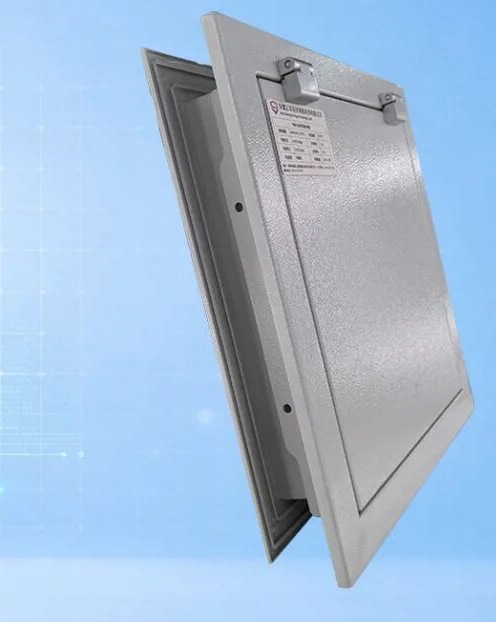
Pressure-relief vent. The panel that closes the relief opening — slim profile, powder-coated for outdoor and coastal sites, high sensitivity at low opening pressure, and a single-piece assembly with nothing to adjust at inspection. -
No water onto an energised battery
At the DC voltages inside a container, a water jet is a conduction path. Spraying before the array is confirmed dead risks insulation breakdown, arcing and a second event worse than the first. Water is a legitimate cooling tool only after complete isolation and after the area has been cleared — and then from a distance, as a sustained stream rather than a knockdown.
-
Cabinet-level protection beats compartment-level protection
Detection and discharge inside the cabinet see the fault earlier and can hold the damage to one cabinet. Compartment-level suppression is the backstop, not the primary defence: it acts after the event has already filled the room. A quotation that offers only compartment-level protection is not a cheaper version of the same design; it is a different and weaker one.
-
The system has to be proved on a schedule
Cylinder pressure, pipework tightness, detector sensitivity and the linkage signal path all drift without anyone noticing. A large share of the installations we are asked to look at are not wrong-agent installations; they are systems that had not been inspected for years and did not operate when the alarm was real. Put the annual test in the maintenance contract, not only in the commissioning report.
Energy-storage fire protection is a chain, and the agent is one link in it. Detection, electrical isolation, pressure relief and routine inspection all have to hold, because the weakest link sets the outcome. Know where each component’s limit is, design to the standard rather than to the price, and test against a calendar — that is what keeps a storage plant inside its safety envelope for the twenty years it is expected to run.
- Detection reads gas, CO and temperature together; smoke alone arrives too late.
- The objective is containment and isolation, not extinction of the visible flame.
- Sequence and airtightness fail more systems than agent choice does.