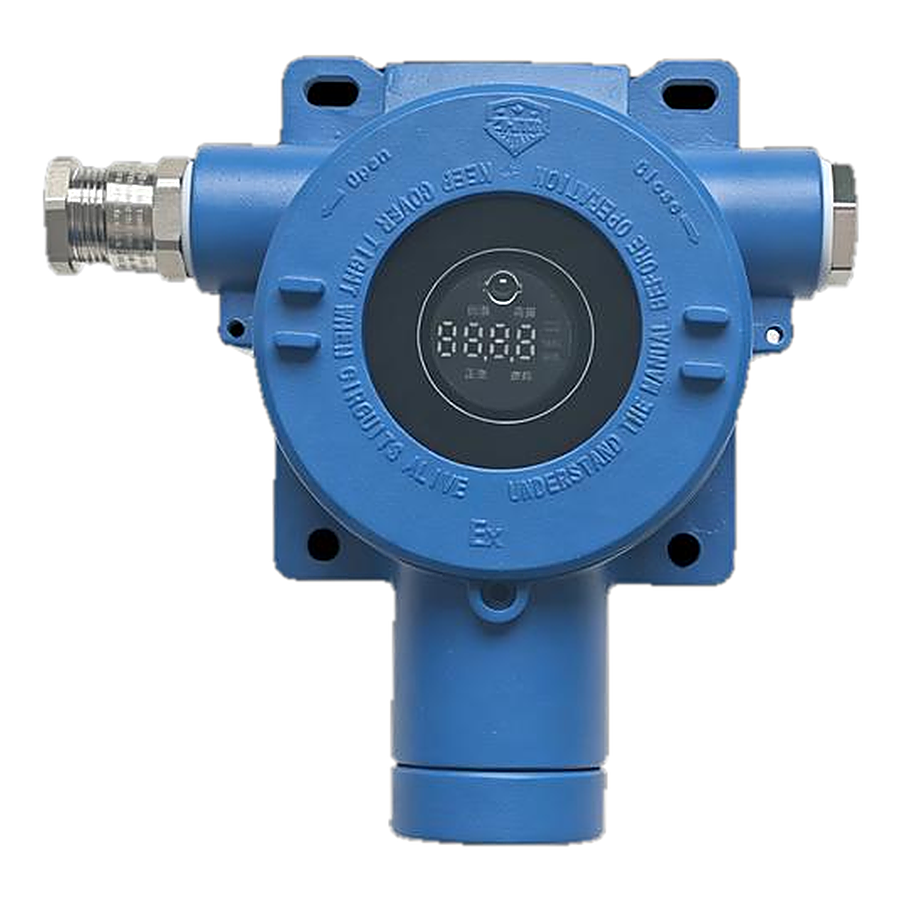
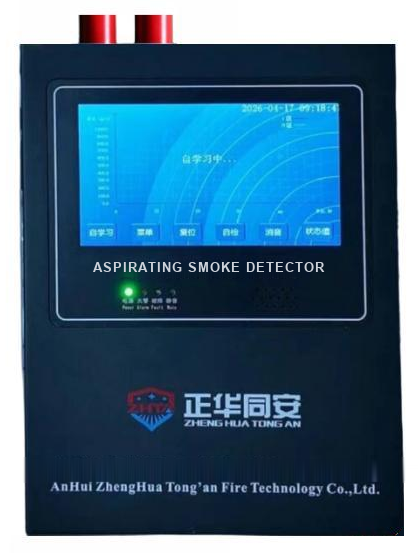
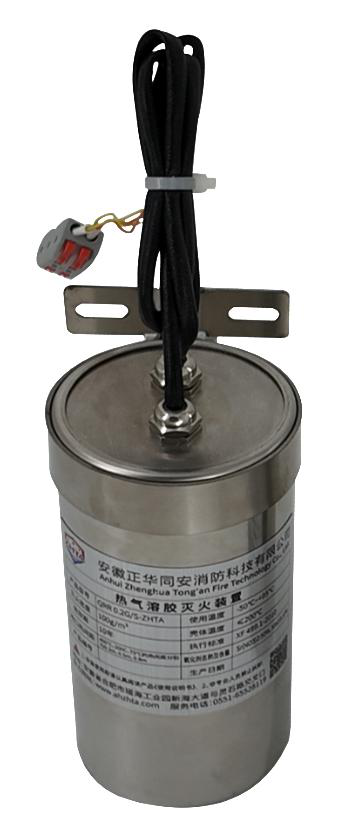
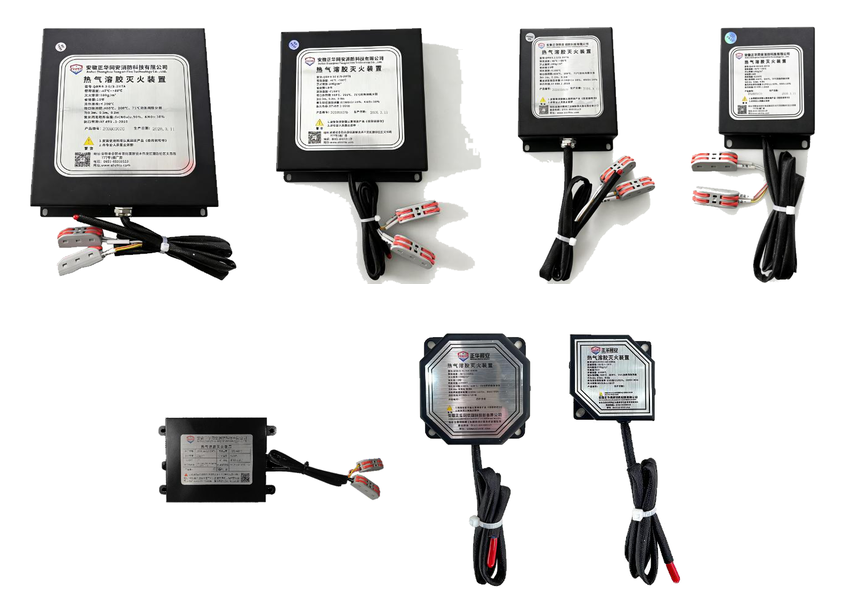
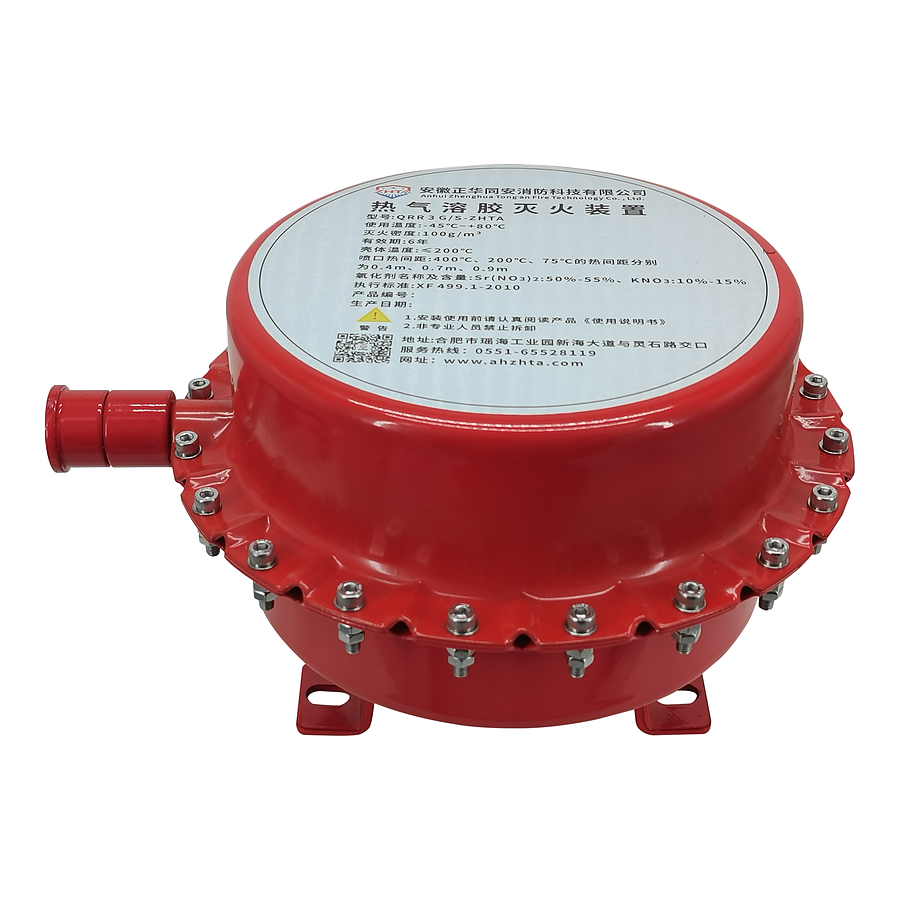
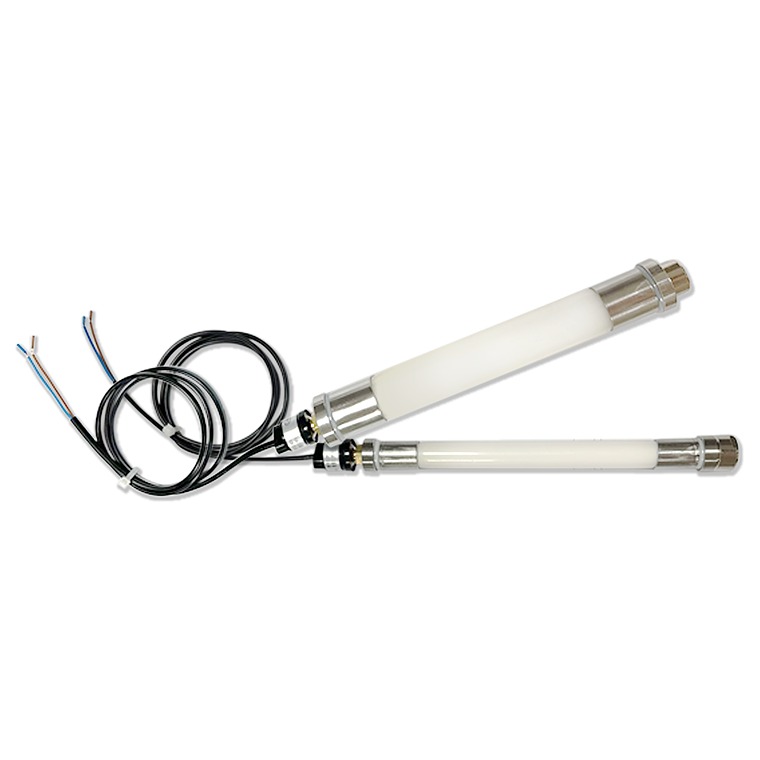
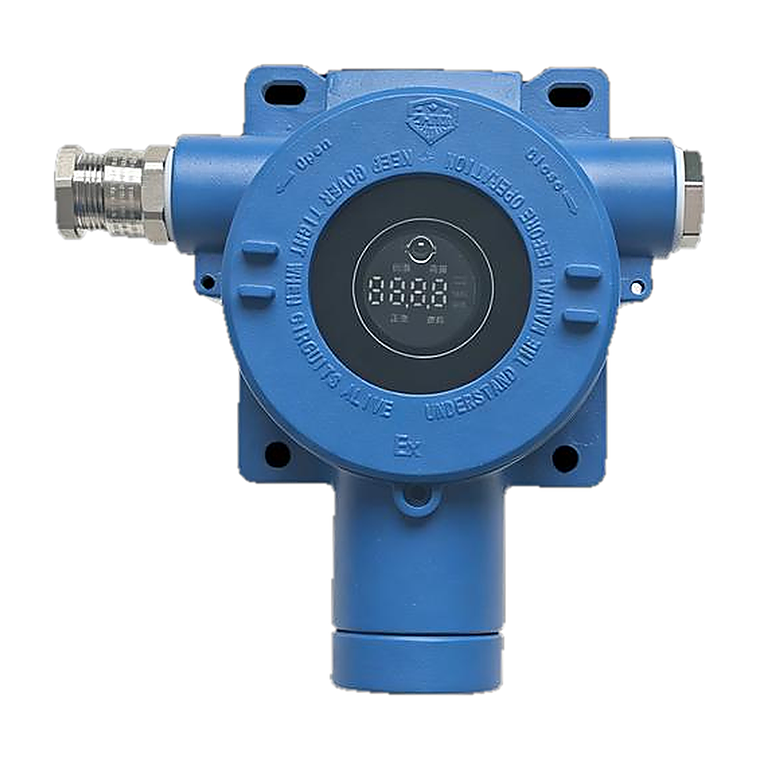
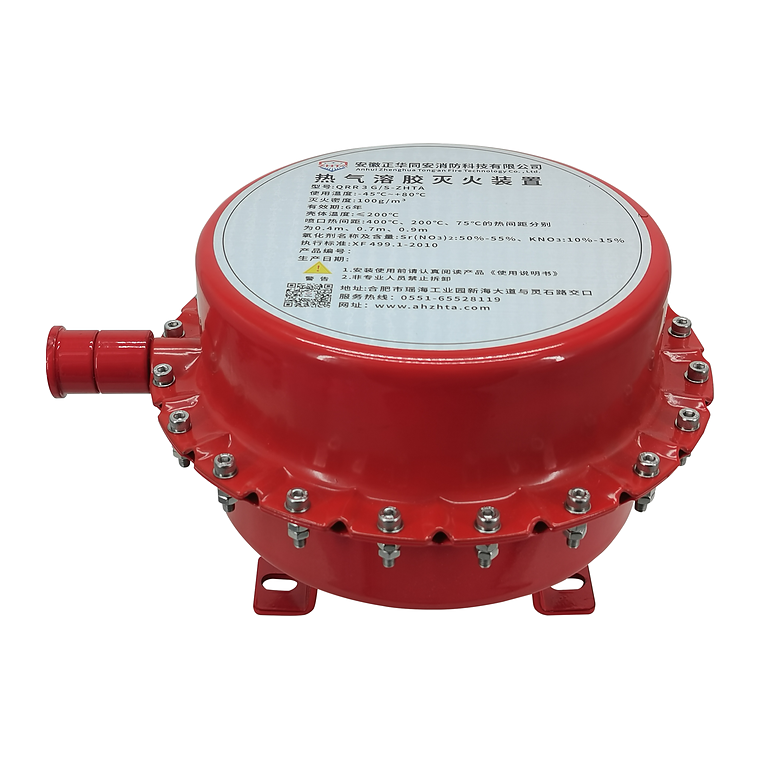
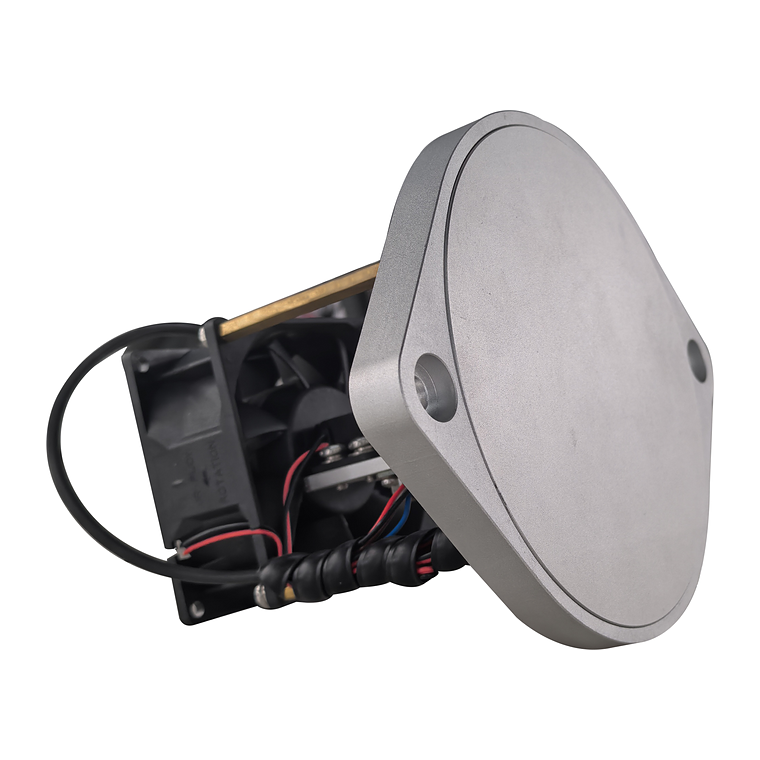
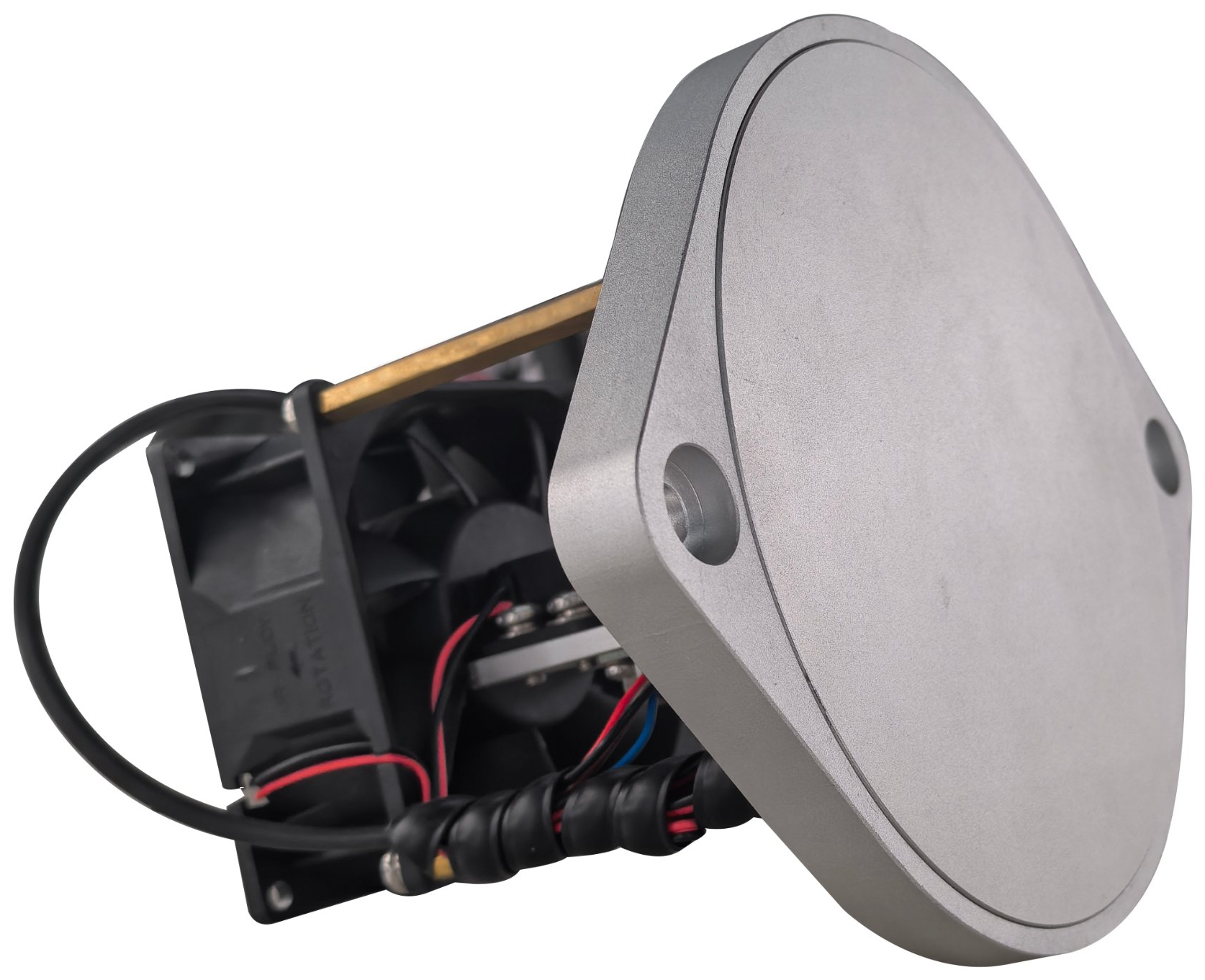
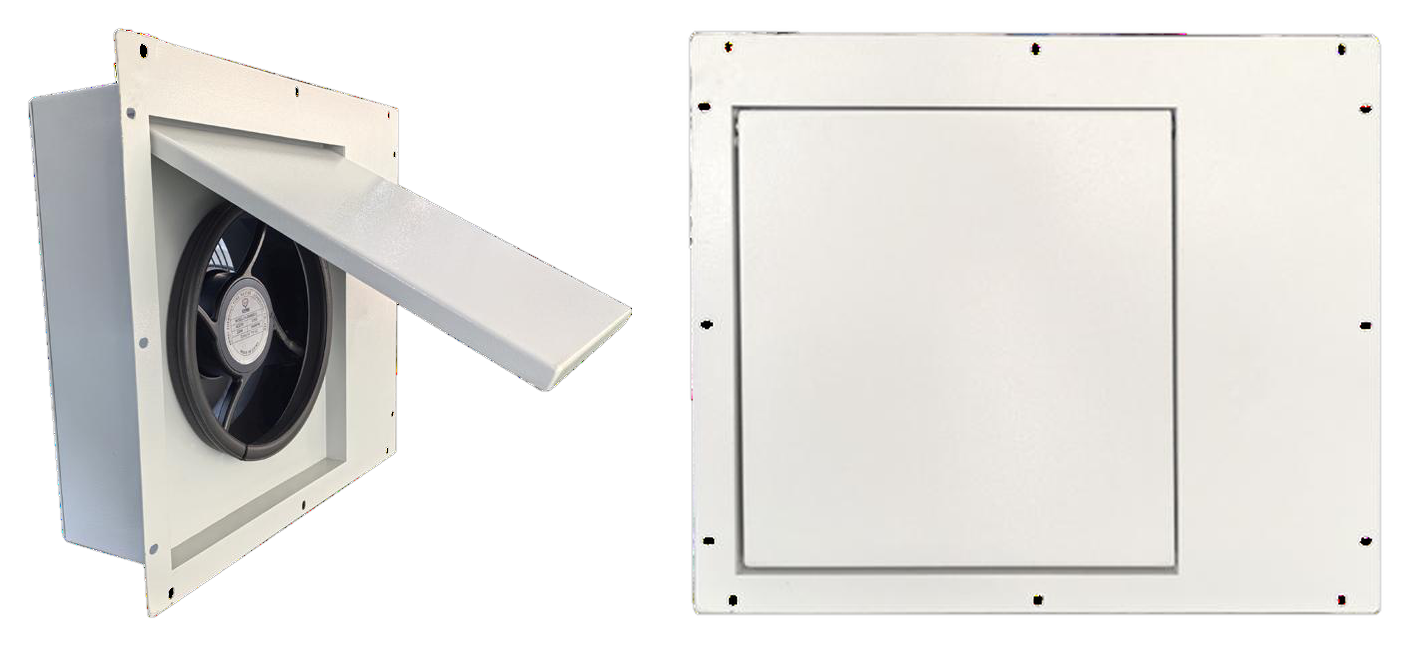
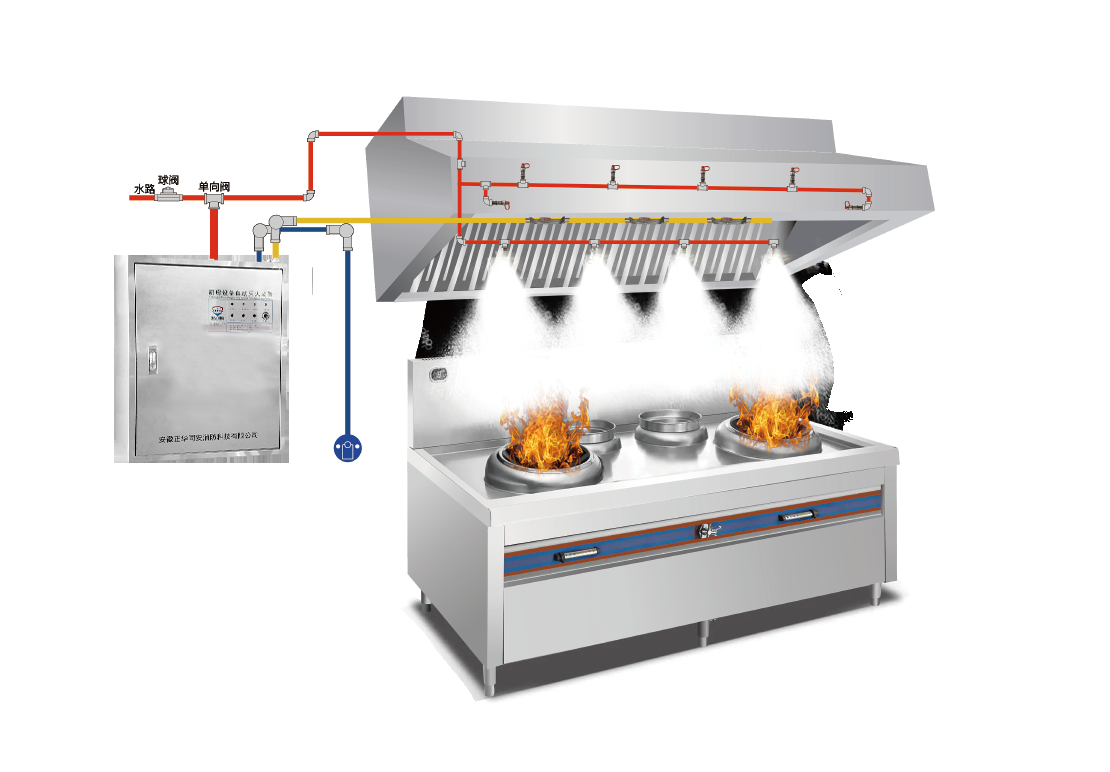
Our core product families, supplied as standalone devices or as a complete engineered system with calculation, drawings and commissioning support.
01GQQ series
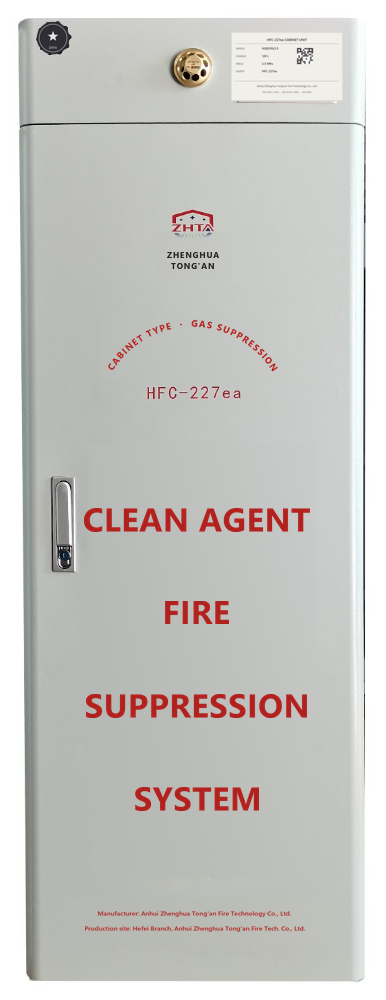
HFC-227ea · Cabinet type
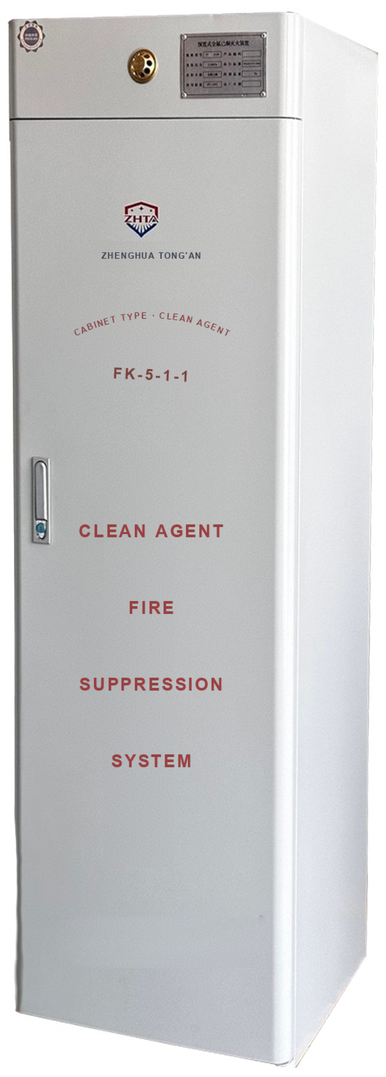
Cabinet type extinguishing device
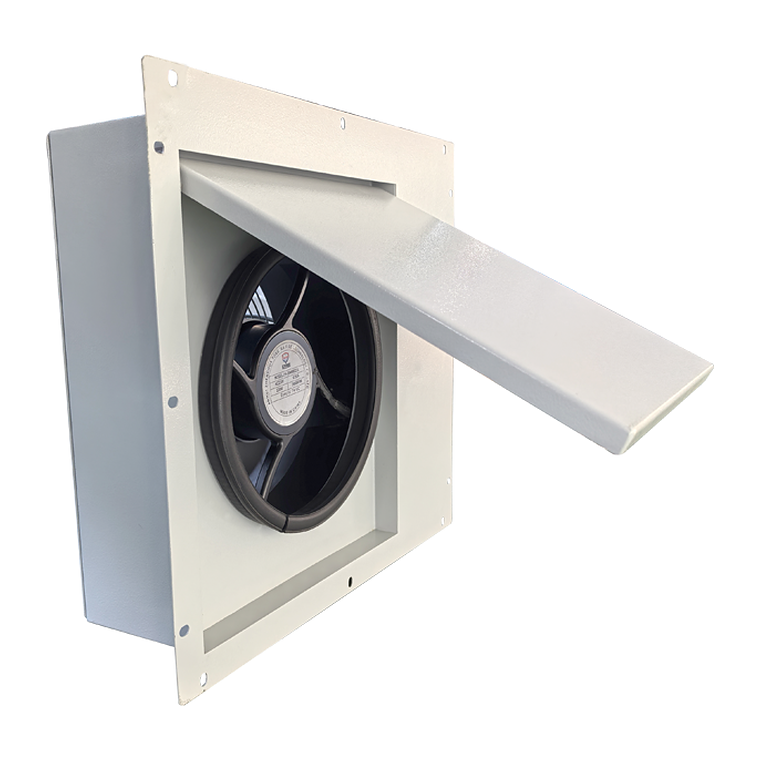
A pre-engineered unit: cylinder, container valve, nozzle and control mounted in one cabinet. No dedicated cylinder room and no pipework, so a single room or enclosure is protected without a system design — and the unit can be moved when the room layout changes.
Computer rooms, telecom shelters, data stores, switchgear and generator rooms, archives and other rooms holding high-value equipment.
Single room protectionNo pipeworkWall or floor mountedManual + automatic release7–15 day lead timeODM / OEM
7–15 days from order to a finished, filled and pressure-tested unit. ODM / OEM supply available — your branding, cabinet configuration and packaging.
Specifications
Single-cylinder units
Model
Storage pressure
Cylinder
Fill density
Max. working pressure
Cabinet L×W×H (mm)
GQQ40/2.5
2.5 MPa (20 °C)
40 L
≤1120 kg/m³
4.2 MPa (50 °C)
460×460×1300
GQQ70/2.5
70 L
500×500×1450
GQQ90/2.5
90 L
500×500×1650
GQQ100/2.5
100 L
GQQ120/2.5
120 L
GQQ150/2.5
150 L
500×500×1900
GQQ180/2.5
180 L
520×520×2100
Double-cylinder units
Model
Storage pressure
Cylinder
Fill density
Max. working pressure
Cabinet L×W×H (mm)
GQQ90×2/2.5
2.5 MPa (20 °C)
90 L × 2
≤1120 kg/m³
4.2 MPa (50 °C)
900×500×1600
GQQ120×2/2.5
120 L × 2
900×500×1900
Release sequence: smoke and heat detection alarm together → fire alarm panel → sounder and “gas release” warning → unit discharge → pressure-relief vent opens.
02XQQCW series
HFC-227ea · Hanging type
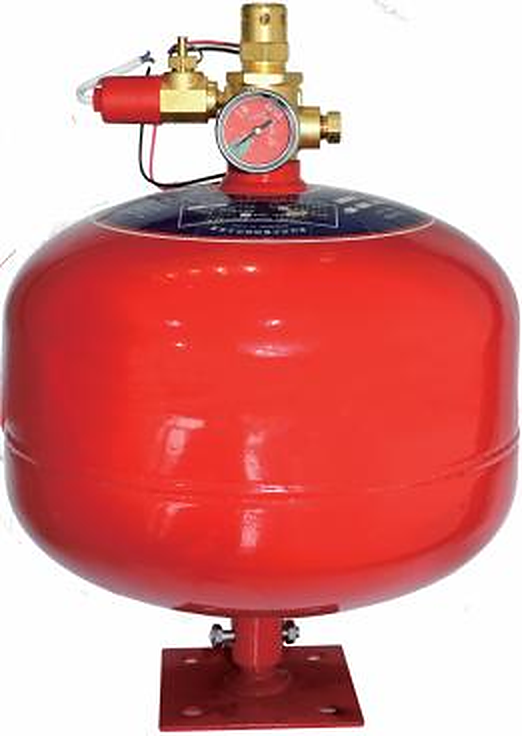
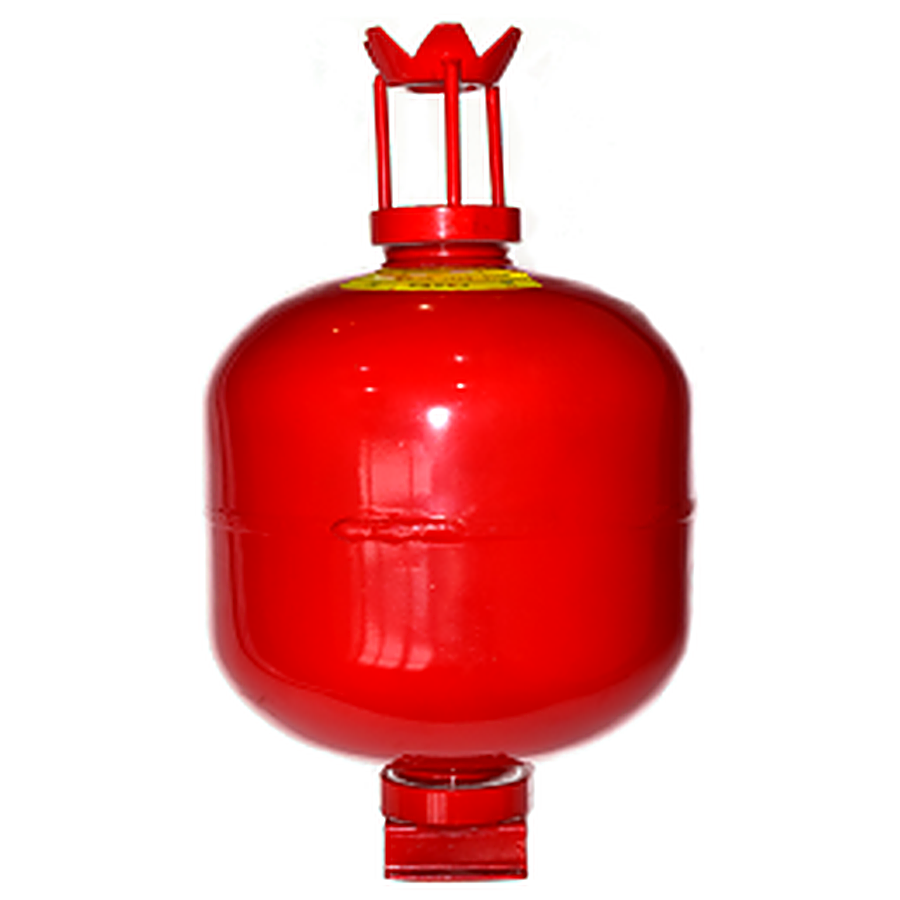
Hanging type device
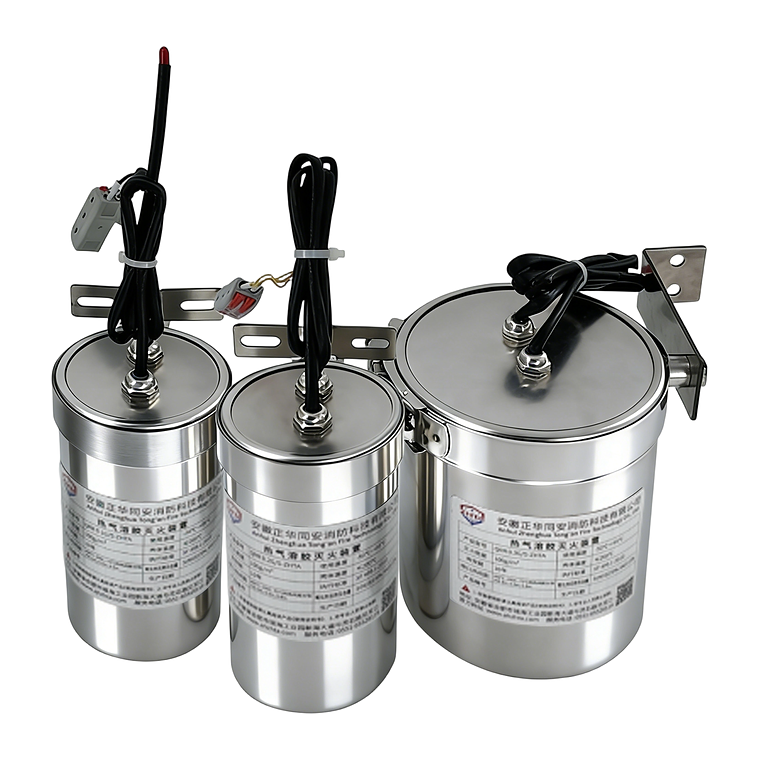
A self-contained unit built from an agent cylinder, container valve, solenoid actuator, nozzle, thermal glass bulb, pressure feedback switch and hanging bracket — suspended from the ceiling of the protected space. No agent pipework and no dedicated cylinder room: the device hangs where the fire risk is, is fixed with one bracket and wired to the alarm panel. Release is automatic by thermal bulb or electric by DC 24 V signal.
Computer and data-processing rooms, telecom facilities, process control centres, medical equipment rooms, museums, libraries and archives, valuables stores, emergency power rooms, flammable liquid stores and cleanrooms — plus production hazards such as paint lines, electrical ageing rooms, rolling mills, printing presses, melting tanks, drying equipment and coal-powder silos, and ship engine rooms and cargo holds. Especially suited to small enclosed spaces.
Ceiling suspendedNo pipework68 °C bulb + DC 24 V solenoidTotal flooding≤10 s discharge7–15 day lead timeODM / OEM
No pipework, no cylinder room. The device hangs in the room it protects — no wall penetrations, no pipe runs, no ancillary steelwork, no separate storage room.
Made for small and awkward spaces. Telecom shelters, equipment enclosures, small archives and cabinets where floor area is at a premium and a piped system will not fit.
Two independent release paths. A 68 °C thermal glass bulb actuates the unit on its own with no power at all, and a DC 24 V solenoid release links it to the fire alarm panel.
Simple structure, reliable performance. Container valve, actuator and nozzle only — few moving parts, nothing to adjust on site.
Fast to install, easy to maintain. Supplied filled and pressure tested; one bracket on the ceiling plus a control cable, and the unit is in service.
Clean total-flooding agent. HFC-227ea is non-conductive, leaves no residue and is suitable for Class A, B, C and E fires and for rooms in normal occupation.
Agent cylinderContainer valveSolenoid actuatorNozzle68 °C thermal bulbPressure feedback switchHanging bracket
7–15 days from order to a finished, filled and pressure-tested unit. ODM / OEM supply available — your branding, cylinder configuration and packaging.
Specifications
XQQCW series — 10 / 20 / 30 kg units
Parameter
XQQCW10/1.6-ZHTA
XQQCW20/1.6-ZHTA
XQQCW30/1.6-ZHTA
Agent charge
10 kg
20 kg
30 kg
Storage pressure
1.6 MPa (20 °C)
Max. working pressure
2.5 MPa (50 °C)
Fill density
≤1120 kg/m³
Extinguishing method
Total flooding
Discharge time
≤10 s
Actuation
Fixed-temperature bulb 68 °C · DC 24 V solenoid
Operating temperature
0 °C to 50 °C
Release sequence, thermal: bulb reaches 68 °C → bulb bursts → container valve opens → agent discharges in ≤10 s → pressure feedback signal returned. Release sequence, electric: detector alarm → panel confirms and outputs DC 24 V → thermal actuator heats to release temperature → valve opens → agent discharges → feedback signal returned.
03JJQR series
HFC-227ea · Rack-embedded
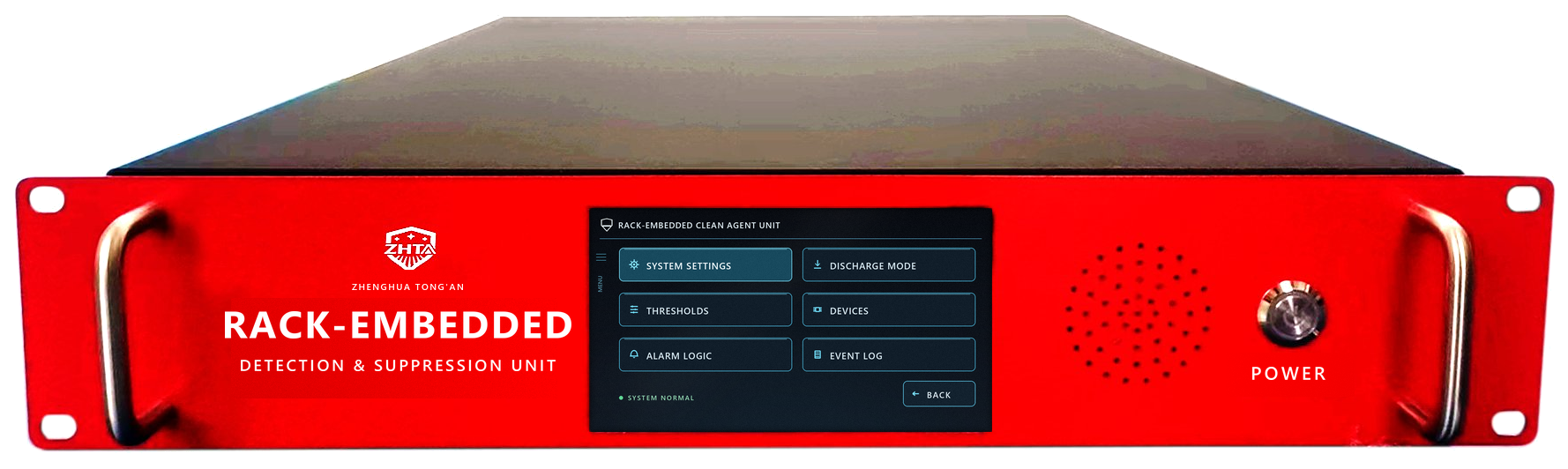
Rack-embedded extinguishing device
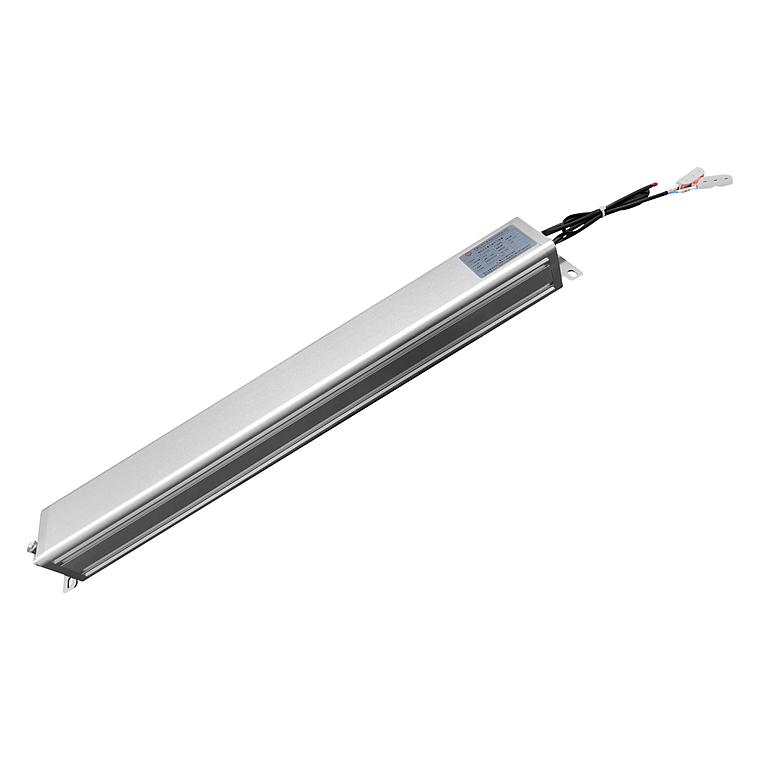
A 2U or 4U module that slides into the server rack and puts detection and total-flooding HFC-227ea suppression inside the cabinet itself — no pipework, no cylinder room, nothing mounted outside the enclosure. Each unit carries its own agent cylinder, thermal release, solenoid actuator, nozzle and pressure gauge, and reports a discharge back to the fire panel over a dry contact.
Computer-room and data-centre racks, C&I energy-storage cabinets, telecom racks, HV/LV switchgear cabinets, archive and artefact rooms.
2U / 4U rack frameFits standard rails68 °C bulb + DC 24 V≤10 s dischargeCAN / RS485 (Z version)20–30 day lead timeODM / OEM
Built for the cabinet, not the room. Detection and agent storage sit in the same 2U / 4U module, so the agent discharges where the fire starts instead of flooding the whole space.
Interchangeable by design. One series covers 2U and 4U frames — a unit of the same size can be replaced without reworking the rack.
Slide-in installation. The footprint matches a standard rack drawer unit: fix it to the rails at mid-height or above and it is in service.
Two independent release paths (W/C). A 68 °C thermal release works with no power at all, while the DC 24 V solenoid lets the panel fire it remotely; the pressure switch returns a dry contact, open in service and closed after discharge.
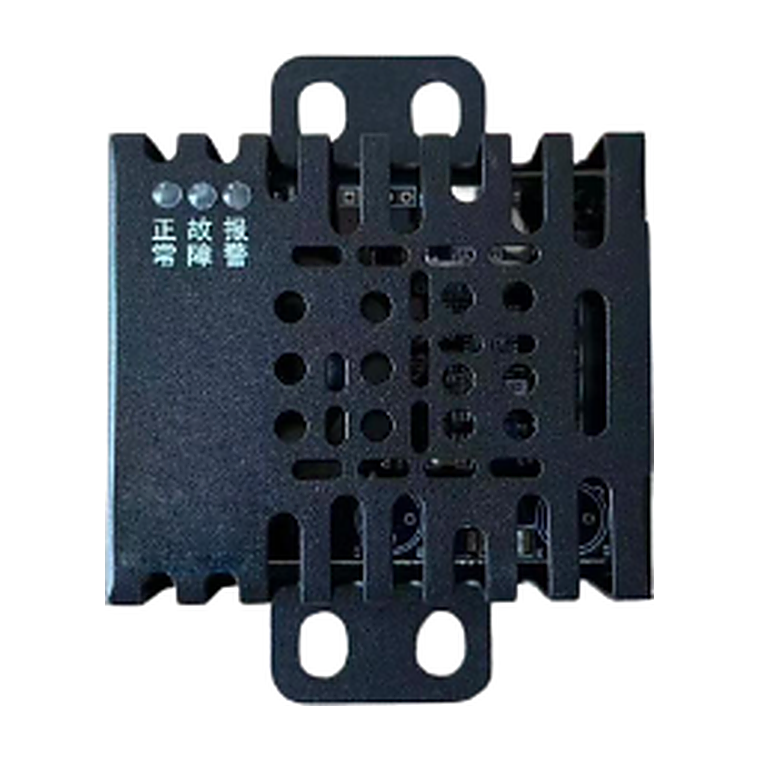
Smart version: touchscreen and telemetry (Z). Colour touchscreen, CAN and RS485, four dry-contact inputs, configurable multi-sensor alarm logic (smoke, heat, CO, H₂, VOC), 2 000-record logs, 0–255 s spray delay and a LiFePO₄ backup battery — third-party platforms can watch every cabinet in the room.
Clean agent, no residue. HFC-227ea is non-conductive and leaves nothing behind on boards, so a discharge does not destroy the equipment it just saved.
Agent cylinder68 °C thermal releaseDC 24 V solenoidNozzlePressure gaugeDry-contact feedbackSmart control unit (Z)Rack mounting bracket
20–30 days from order to a finished, filled and pressure-tested unit. ODM / OEM supply available — your branding, agent charge, faceplate and packaging.
Specifications
JJQR series — model range
Model
Release
Agent charge
Rack
Dimensions L×W×H (mm)
JJQR-Q-W/C-1.5×2/1.2-ZHTA
Thermal + solenoid
3 kg (2 × 1.5)
2U
570×485×89
JJQR-Q-W/C-6/1.2-ZHTA
Thermal + solenoid
6 kg
4U
570×485×176
JJQR-Q-Z-1.5×2/1.2-ZHTA
Smart controller
3 kg (2 × 1.5)
2U
570×485×89
JJQR-Q-Z-6/1.2-ZHTA
Smart controller
6 kg
4U
570×485×176
Common data — W/C (thermal + solenoid) and Z (smart) versions
Parameter
W/C version
Z version
Storage pressure
1.2 MPa
1.2 MPa
Discharge time
≤10 s
≤10 s
Operating temperature
0 °C to 50 °C
0 °C to 50 °C
Operating humidity
—
<95% RH
Release trigger
68 °C bulb · DC 24 V
Panel logic · DC 24 V
Pre-discharge delay
None
0–255 s (default 30 s)
Pressure indication
Pressure gauge
Gauge + LCD
Signal feedback
Dry contact, open → closed after discharge
Dry contact + bus telemetry
Supply
Not required
AC 220 V · LiFePO₄ 21.6 V / 3.6 Ah backup
Output
—
DC 24 V / 2 A
Communication
—
1 × CAN, 1 × RS485
Mounting
Rack rails, mid-height or above
Rack rails, mid-height or above
Designed to GB 50370-2005 (gas extinguishing system design), GB 25972-2010 (systems and components) and GB 18614-2012 (HFC-227ea agent). Release sequence, W/C: 68 °C reached or DC 24 V signal → release opens → agent discharges in ≤10 s → pressure-switch contact closes and signals the panel.
HFC-227ea · Detection tube
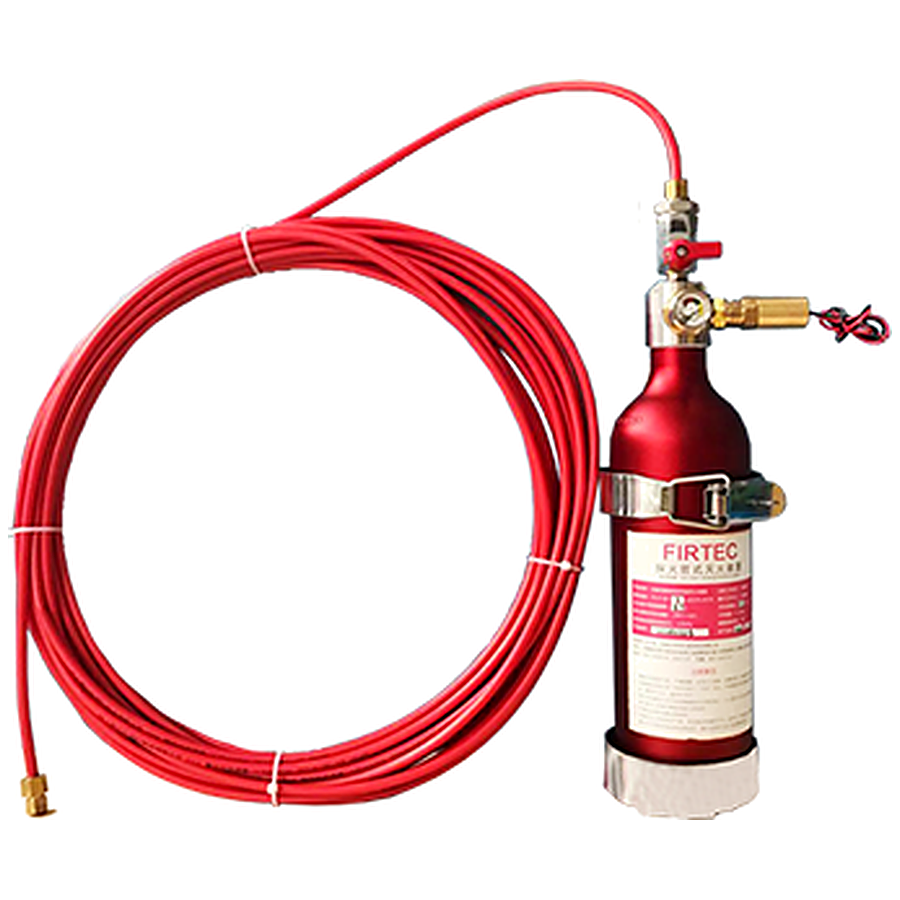
Detection tube extinguishing device
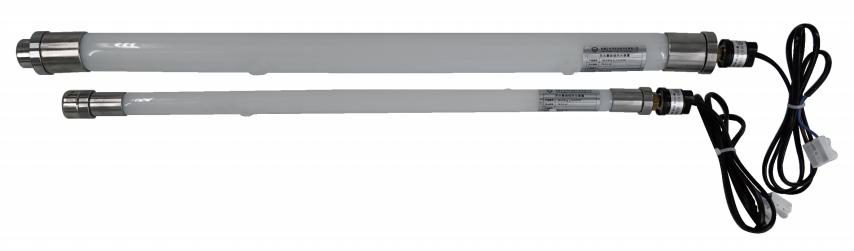
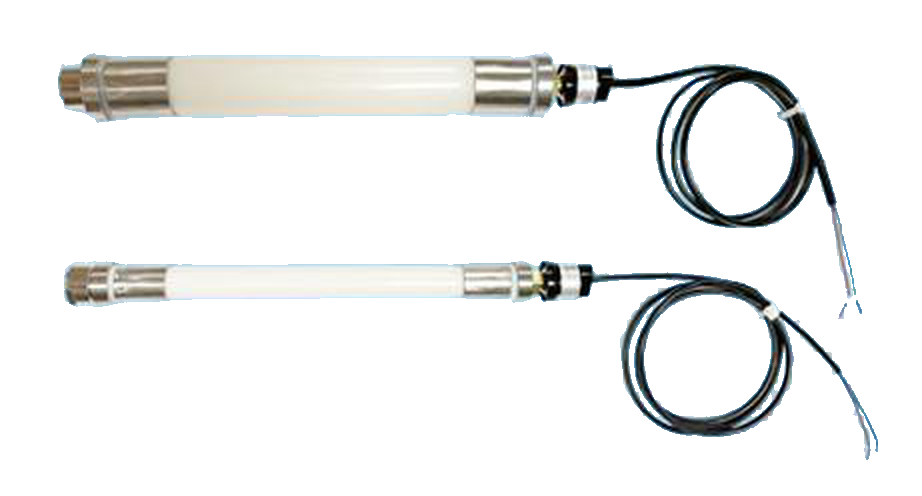
The tube is the detector, the nozzle and the switch. A 6 mm pressurised tube runs from a small HFC-227ea cylinder through the space being protected and holds its pressure while nothing is wrong. Heat softens the tube wall until it bursts at the hottest point — the agent goes straight out of that hole onto the fire, seconds later, with no detector to confirm the alarm and no panel to authorise the release.
Switchgear and control cabinets, server and telecom racks, CNC and machine tool enclosures, motor and generator compartments, archives and small rooms — anywhere a cylinder room, a pipe run or a 220 V supply is impractical.
0.75 kg HFC-227ea6 mm detection tubeNo power, no wiringDirect release at the burstCeiling / top mount20–30 day lead timeODM / OEM
One component does three jobs. The same tube detects the fire, opens the release and becomes the nozzle — there is no detector loop, no solenoid, no control panel and no wiring to commission.
It discharges where it is hottest. The tube fails at its hottest point, so the agent leaves the tube inside the cabinet or right above the fire instead of at a fixed ceiling nozzle — the shortest possible path to the seat of the fire.
Works with the power off. Release is purely mechanical and thermal: a dead cabinet, a tripped supply or a missing battery backup does not stop it, and there is nothing electrical to fail in storage.
Certified knock-down. In the type test the flame was out within 1 s of the release and did not reignite within 1 min, against a requirement of 30 s — tested by the National Centre for Quality Inspection of Building Fire Products (CNAS L1449).
Fits what a pipe system cannot. A 6 mm tube follows the inside of a cabinet, a rack or a machine housing; the cylinder sits beside it, so a single enclosure is protected without a cylinder room or a pipe run.
Clean agent, clean recovery. HFC-227ea is electrically non-conductive and leaves no residue, so switchgear, boards and instrument faces are usable again after ventilation — only the burst tube is replaced.
HFC-227ea cylinder6 mm pressurised tubeThermal burst releaseDirect discharge at the burstNo electrical supplyCeiling / top mountingSingle-use tube
20–30 days from order to a finished, filled and pressure-tested unit — production and agent filling both inside that window. ODM / OEM supply available: your branding, agent charge, tube length, bracket and packaging.
Specifications
MZ-QW series — detection tube device, type-tested
Parameter
MZ-QW-0.75/1.6-ZHTA
Model
MZ-QW-0.75/1.6-ZHTA
Product type
Detection tube automatic extinguishing device
Agent
HFC-227ea (heptafluoropropane)
Agent charge
0.75 kg
Detection & release
6 mm pressurised tube — bursts at the hottest point, agent discharges from the burst
Electrical supply
Not required
Extinguishing method
Total flooding of the enclosure (type test: full-flooding, class B fire)
Protected volume (as tested)
1.004 m³ — test enclosure 0.621 × 0.803 × 2.014 m
Mounting in test
Vertical, at the top centre of the enclosure, above the fire tray
Discharge performance
Flame extinguished within 1 s of release; no re-ignition within 1 min (requirement: ≤30 s)
Product standard
Q/ZHTA 09-2023 · tested to XF 499.1-2010
Type test report
FH2024QC0017 — National Centre for Quality Inspection of Building Fire Products, Beijing Building Materials Testing Academy (CNAS L1449 · MA 220020349635)
Lead time
20–30 days including production and agent filling
Supply terms
ODM / OEM
Release sequence: tube pressurised → fire heats the tube → the wall softens and bursts at the hottest point → HFC-227ea discharges from the burst directly onto the fire → flame out, enclosure flooded. There is no detector, panel or solenoid in the path, so the sequence cannot be blocked by a power failure or a fault in the alarm system.
HFC-227ea · Detection tube system
Detection tube cylinder unit
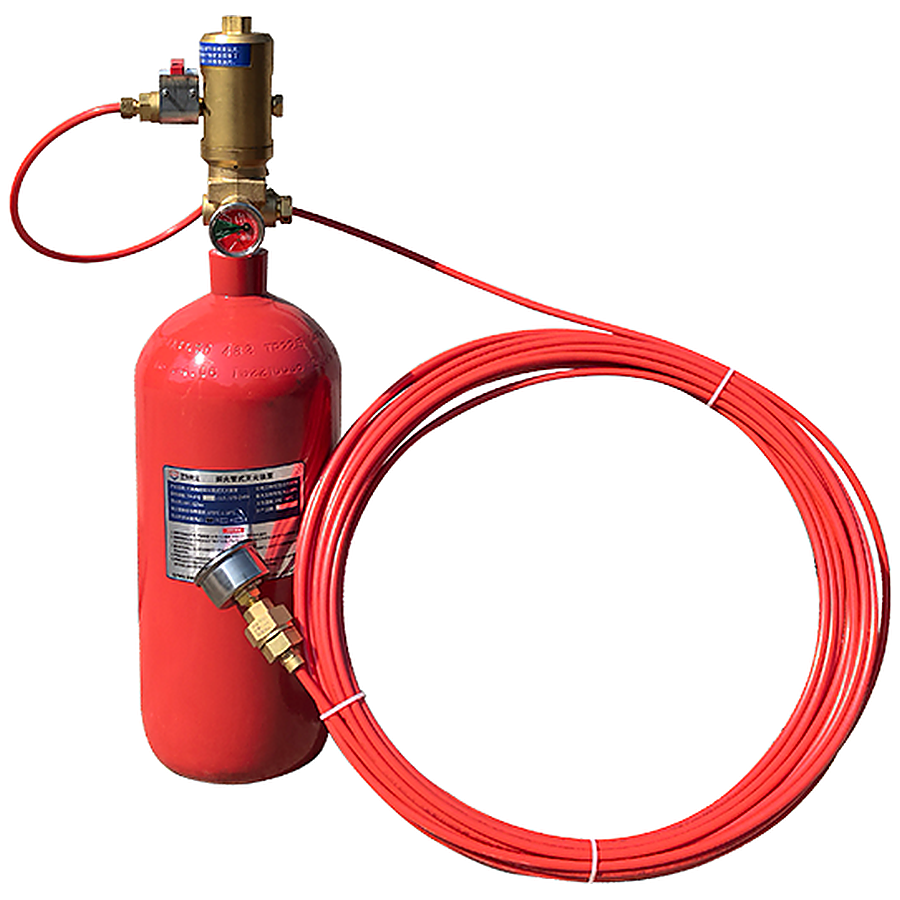
A cylinder-based detection tube system: the HFC-227ea sits in a seamless steel cylinder at 2.5 MPa and the tube leaves the container valve, threads through the space being protected and ends in a pressure gauge. Heat softens the tube at 170 ± 10 °C until it bursts, and the agent is discharged through that opening — the tube is the sensor, the pipe and the nozzle at once.
Electrical cabinets, control and drive enclosures, machine compartments, archives, showcases and small stores of up to 20 m of tube run — with no detector, no release panel and no wiring to the valve.
3 / 4 / 6 kg HFC-227ea2.5 MPa storage170 ± 10 °C tube burstUp to 20 m of tubeNo power required20–30 day lead timeODM / OEM
The tube detects, routes and discharges. One 6 × 1 mm tube replaces the detector, the release circuit and the discharge pipework: it bursts at 170 ± 10 °C and the agent leaves exactly where the heat is.
Long, flexible coverage. Up to 20 m of tube per unit — long enough to thread through several cabinets or a machine housing, with no nozzle spacing calculation and no fixed pipe layout to design.
Nothing electrical at the release point. The container valve is opened by the tube pressure drop, so a dead panel, a lost supply or a fault in the alarm loop cannot stop the discharge.
Three charges on one platform. 3, 4 and 6 kg versions share the same valve, tube and mounting detail, so a project steps up in agent weight without changing the installation or the spares list.
Type-tested to XF 1167-2014. Full type test at the National Centre for Quality Inspection of Fixed Fire-extinguishing Systems and Fire-resisting Components (CNAS L0988), report Gn202401252 — including container, valve and relief device.
Clean and safe on live equipment. HFC-227ea is electrically non-conductive and leaves no residue, so switchgear and electronics are usable again after ventilation — nothing to clean out of the cabinet.
20–30 days from order to a finished, filled and pressure-tested unit — production and agent filling both inside that window. ODM / OEM supply available: your branding, agent charge, tube length, bracket and packaging.
Specifications
TH-Z-Q series — cylinder + detection tube, 3 / 4 / 6 kg
Parameter
TH-Z-Q-3/2.5/170-ZHTA
Models
TH-Z-Q-3 / TH-Z-Q-4 / TH-Z-Q-6 (2.5 / 170) — ZHTA
Agent
HFC-227ea (heptafluoropropane)
Agent charge
3 kg / 4 kg / 6 kg
Container
Seamless steel cylinder, 4 L, nominal working pressure 4.8 MPa
Storage pressure
2.5 MPa at 20 °C · max. working pressure 4.2 MPa
Max. fill density
750 kg/m³
Container valve
QTRF12/4.2 · nominal working pressure 4.2 MPa
Relief device
LP7-5.9-A/ZH — actuates at 5.9 ± 0.295 MPa
Detection tube
6 × 1 mm (OD 6 mm, ID 4 mm), max. length 20 m per unit
Tube actuation
Static actuating temperature 170 ± 10 °C
Working temperature
0 °C … +50 °C
Nozzle
None — discharge from the burst tube
Standard & test
XF 1167-2014 · type test report Gn202401252 (CNAS L0988)
Lead time
20–30 days including production and agent filling
Supply terms
ODM / OEM
Release sequence: cylinder charged to 2.5 MPa, tube supervised by the pressure gauge → fire raises the tube to 170 ± 10 °C → the tube bursts at the hottest point → the pressure drop opens the container valve → HFC-227ea discharges through the burst → the tube is replaced and the unit is recharged.
01FK-5-1-1 systems
FK-5-1-1 · Rack-embedded
Rack-embedded extinguishing unit
One 2U or 4U module, four parameter sets. The unit slides into the rack and puts detection and total-flooding FK-5-1-1 suppression inside the enclosure — agent cylinder, release valve, nozzle, pressure gauge and feedback terminals on one chassis, nothing mounted outside the cabinet. The same body is built in two release versions, thermal bulb plus DC 24 V solenoid (W/C) or an intelligent controller with multi-sensor detection and CAN / RS485 telemetry (Z), each in 3 kg and 6 kg.
Computer-room and data-centre racks, C&I energy-storage cabinets, telecom racks, HV/LV switchgear cabinets, archive and artefact rooms.
2U / 4U rack frame3 kg & 6 kg1.2 MPa storage68 °C bulb + DC 24 VCAN / RS485 (Z)20–30 day lead timeODM / OEM
Built for the cabinet, not the room. Detection and agent storage share the 2U / 4U chassis, so the agent discharges where the fire starts — no cylinder room, no pipework, no room-level design.
Two independent release paths. A +68 °C thermal bulb fires the unit on its own with no supply at all, and a DC 24 V solenoid lets the panel or controller fire it remotely. Either one discharges.
Slide-in interchangeability. 2U and 4U are one series: the footprint matches a standard rack drawer, the unit fixes to the rails at mid-height or above with ±5 mm tolerance, and a same-size unit swaps straight in.
Intelligent option on the same body. Multi-sensor detection (smoke, heat, CO, H₂, VOC) with per-sensor thresholds, 0–255 s pre-discharge delay, alarm / fault / start-stop logs and a LiFePO₄ backup battery; CAN and RS485 let a third-party platform watch every cabinet.
Positive confirmation of discharge. Dry contact, normally open in service and closed after a discharge, straight to the fire panel or BMS — and the pressure gauge stays readable from the front face.
Clean agent, no clean-up. FK-5-1-1 boils at 49 °C and leaves as an electrically non-conductive vapour: no powder, no water, no residue on boards.
Agent cylinderRelease valve+68 °C thermal releaseDC 24 V solenoidNozzlePressure gaugeDry-contact feedbackIntelligent controller (Z)
20–30 days from order to a finished, filled and pressure-tested unit — production and agent filling both inside that window. ODM / OEM supply available: your branding, agent charge, faceplate and packaging.
Release (W/C): 68 °C reached or DC 24 V signal → valve opens → agent discharges in ≤10 s → feedback contact closes. Release (Z): detector alarm → controller counts down 0–255 s → solenoid fires → discharge → dry contact + bus event recorded.
02YF series
FK-5-1-1 · Cabinet type
Cabinet type extinguishing device
A pre-engineered cabinet built around a genuine FK-5-1-1 cylinder: container valve, nozzle, pressure gauge and release controls in one steel shell, supplied filled and pressure tested. No cylinder room, no pipework and no system design for a single room — fix it to the wall or the floor, wire it to the fire panel, and the room is protected. The agent is the same fluoroketone used in our rack units, dried to a moisture content of 10 ppm or less before filling.
Computer-room and telecom racks, data-centre cabinets, HV/LV switchgear, generator rooms, archives, museums and artefact stores — and, because the agent cools the flame zone as well as displacing oxygen, battery energy-storage cabins and lithium-ion production and storage areas.
40 / 70 / 90 / 120 L2.5 MPa storage≤10 s dischargeTotal floodingClean, non-conductive agent20–30 day lead timeODM / OEM
One cabinet, no plant room. Cylinder, container valve, nozzle, gauge and release controls sit in the same shell, so a single room needs no cylinder room, no pipe run and no room-level calculation — and the unit can be moved when the room is reorganised.
Four sizes, one family. 40, 70, 90 and 120 litre units share the same cabinet construction, so a protected volume steps up a size without changing the installation detail or the spares list.
Out in ten seconds. Total discharge in ≤10 s. The agent leaves the nozzle as a vapour and takes heat out of the flame zone on the way, so knock-down does not depend on oxygen displacement alone.
Safe on live equipment. FK-5-1-1 is electrically non-conductive, and the agent is dried to ≤10 ppm moisture before filling — a discharge onto switchgear, drives or battery racks neither shorts nor corrodes them.
Nothing to clean up. No powder, no water and no residue: after ventilation the room is usable again, and the equipment the agent just saved is not written off by the agent that saved it.
Holds, and is green. The vapour stays in the enclosure against re-ignition — the real risk in lithium-ion and storage-cabin fires — and the agent has zero ozone depletion, GWP ≈ 1 and an atmospheric lifetime measured in days.
20–30 days from order to a finished, filled and pressure-tested cabinet — production and agent filling both inside that window. ODM / OEM supply available: your branding, agent charge, faceplate and packaging.
Release sequence: smoke and heat detectors alarm together → fire alarm controller → sounder and “agent released — do not enter” warning → cabinet unit discharges in ≤10 s → pressure-relief vent opens.
03MZ-F/W series
FK-5-1-1 · Detection tube
Detection tube extinguishing device
The tube is the detector, the nozzle and the pressure vessel. 750 g of FK-5-1-1 sits in the tube itself at 1.6 MPa — there is no cylinder to mount, no valve to service and no pipework to design. At 110 ± 10 °C the tube wall softens and bursts at its hottest point, and the agent leaves through that opening directly onto the fire.
Switchgear and control cabinets, machine and drive enclosures, battery boxes, server and telecom racks, archives and showcases — one unit protects a space of up to 1 m³, from −40 °C to +80 °C, with no supply and no wiring.
750 g FK-5-1-1φ18 × 3 m / φ30 × 1.2 m1.6 MPa110 ± 10 °C release−40 … +80 °C20–30 day lead timeODM / OEM
The tube replaces the pressure vessel. Agent, storage and release all sit inside one φ18 or φ30 tube: no cylinder, no container valve, no manifold — fewer parts, lower cost and nothing to maintain between inspections.
Thermal release, nothing to detect with. The wall bursts at 110 ± 10 °C on its own, so there is no detector to certify, no panel to program and no 24 V supply to lose in a power failure.
It opens where the fire is. Because the tube fails at its hottest point, the agent is released inside the cabinet or right over the fault instead of at a fixed ceiling nozzle — a short, direct path to the seat of the fire.
Built for hard places. −40 … +80 °C working range and a 200 mm minimum bend radius let the tube follow the inside of a cabinet, a machine housing or a battery box, and one unit covers a protected volume of up to 1 m³.
Fast and confirmed. Discharge in ≤8 s; in the type test the flame was out within 1 s and did not reignite within 1 min. A normally-open dry contact reports the release to the panel or BMS.
Clean agent, export-ready materials. FK-5-1-1 is electrically non-conductive and leaves no residue; the device passed TÜV Rheinland RoHS, PAH and organotin testing (report 180334996a 001), so it can ship into EU-bound equipment.
FK-5-1-1 agentφ18 × 3 m tubeφ30 × 1.2 m tube1.6 MPa storage110 ± 10 °C burstDry-contact feedbackNo power required
20–30 days from order to a finished, filled and pressure-tested unit — production and agent filling both inside that window. ODM / OEM supply available: your branding, tube length and diameter, bracket, label and packaging.
Specifications
MZ-F/W series — one device, two tube sizes
Parameter
MZ-F/W-0.75/1.6-ZHTA
Model
MZ-F/W-0.75/1.6-ZHTA (φ18 / φ30)
Agent
FK-5-1-1 (perfluorohexanone)
Agent charge
750 g
Tube size
φ18 × 14 mm, 3000 ± 5 mm · φ30 × 25 mm, 1200 ± 5 mm
Storage pressure
1.6 MPa
Operating temperature
−40 °C … +80 °C
Release
Thermal — tube bursts at 110 ± 10 °C
Feedback
Dry contact, normally open
Protected volume
≤ 1 m³ per unit
Discharge time
≤ 8 s
Installation
Top of the protected object or the fire-prone area; minimum bend radius R200 mm
Product standard
Q/ZHTA 09-2023 · type-tested to XF 499.1-2010 (report FH2024QC0018)
Release sequence: tube charged to 1.6 MPa → heat raises the tube wall to 110 ± 10 °C → it bursts at the hottest point → FK-5-1-1 discharges from the burst in ≤8 s → flame out and the dry contact changes state. In the type test — 1.004 m³ enclosure, unit at the ceiling centre — the flame was out within 1 s and did not reignite within 1 min.
04MQF650 series
FK-5-1-1 · Handheld
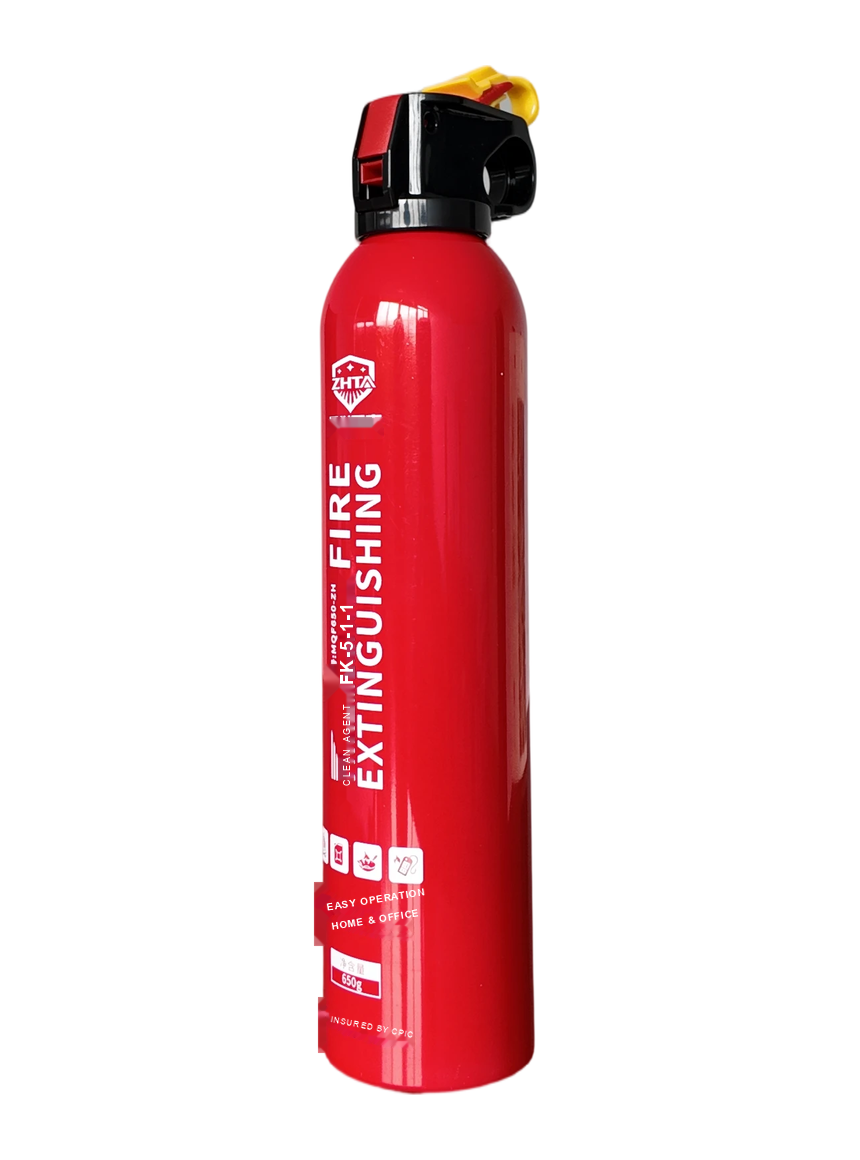
Handheld extinguishing spray
A 650 g can of FK-5-1-1 with a pull-and-press head: the first response for a fire that has just started. There is no pin to pull and no hose to unroll — release the tab, press the head, and eight seconds of agent goes out two metres or more. Because the agent is non-conductive and evaporates completely, it can be used on a live vehicle circuit, a socket or a battery pack without shorting it or writing it off.
Initial fires in EV and lithium-ion packs, vehicle and appliance wiring, seat foam, documents and artwork, switchgear, and kitchen oil pans — the fires that are still small enough to stop by hand.
650 g FK-5-1-1≥ 8 s discharge≥ 2 m throw−10 … +60 °C4-year shelf life15-day lead timeODM / OEM
One pull, one press. The head is opened with a single movement and the agent is released by pressing down — no pin, no hose, no training, which is what matters when the fire is thirty seconds old.
Safe on live equipment. Vaporised FK-5-1-1 does not conduct, so the spray can go onto an energised vehicle circuit, a socket outlet or a lithium-ion pack without the shock risk of water or foam.
No residue, no clean-up. The agent evaporates completely instead of leaving powder or water in the equipment — the appliance, the wiring or the artwork it just protected is not written off by the agent that saved it.
Covers the fires people actually have. A, B, C, E and F class small fires including cooking oil, at a design concentration of 4–6 % — a much lower working concentration than dry powder or CO₂ needs.
Reach without getting close. ≥2 m spray distance and ≥8 s of discharge let the user stand back from a wheel arch, a battery bay or a pan of burning oil and still put agent on the seat of the fire.
Stores anywhere and stays green. −10 … +60 °C working range, four-year shelf life, ≤3 % residual at the end of discharge; ODP = 0, GWP ≈ 1 and an atmospheric lifetime of about five days.
650 g FK-5-1-1Pull-and-press headNon-conductive sprayNo residueA / B / C / E / F fires4-year shelf life
15 days from order to a finished, filled and pressure-tested can — production and agent filling both inside that window. ODM / OEM supply available: your branding, label, cap colour, bracket and packaging.
Specifications
MQF650 series — handheld extinguishing spray
Parameter
MQF650-ZH
Model
MQF650-ZH
Capacity
650 g
Agent
FK-5-1-1 (perfluorohexanone, C₆F₁₂O)
Discharge time
≥ 8 s
Spray distance
≥ 2 m
Residual rate
≤ 3 %
Working temperature
−10 °C … +60 °C
Shelf life
4 years
Operation
Release the safety tab, press the head
Fire classes
A / B / C / E / F — initial (small) fires, including cooking oil
Design concentration
4–6 %
Environmental
ODP = 0 · GWP ≈ 1 · atmospheric lifetime ≈ 5 days
Lead time
15 days including production and agent filling
Supply terms
ODM / OEM
For a fire that has just started: release the tab, aim at the base of the flame from two metres or more, press the head and sweep. One can discharges for eight seconds or more and leaves under 3 % behind — enough for an engine bay, a battery pack, a socket outlet or a pan of oil, and nothing to clean up afterwards.
05TH-Z-QF series
FK-5-1-1 · Detection tube system
Detection tube cylinder unit
A cylinder-based detection tube system for FK-5-1-1: the agent is stored in the container at 1.6 MPa, the tube leaves the container valve and runs through the protected space, and a check valve with pressure display closes the line. At 170 °C the tube softens and bursts where it is hottest, the pressure drops, the valve opens and the agent is discharged through the burst — the tube is the detector, the pipe and the nozzle.
Server and network racks, control and switch cabinets, machine tool and drive enclosures, battery compartments, archives and showcases — one unit for a compact, unmanned space where a panel and a pipe run are not practical.
0.8 / 1.5 / 3.0 kg FK-5-1-11.6 MPa storage170 °C tube burstNo power requiredNon-conductive agent20–30 day lead timeODM / OEM
Release with nothing to power. The tube bursts on temperature (170 °C) and the pressure drop opens the container valve — no detector, no release panel, no solenoid and no wiring, so a power failure cannot disarm it.
The burst point is the nozzle. Agent leaves the tube where the heat is, inside the cabinet or right above the fault, instead of at a fixed ceiling nozzle at the end of a pipe run.
Three charges, one platform. 0.8, 1.5 and 3.0 kg units share the same container valve, check valve and tube layout, so a project grows in agent weight without a new installation detail.
Tested on real fires, not just components. In the type test the unit put out a class B total-flooding fire 17.80 s after the discharge ended and a class A fire in 17.62 s, with no re-ignition after a 10-minute hold.
Safe on energised equipment. FK-5-1-1 is electrically non-conductive and boils away without residue — switchgear, boards and instruments are usable again after ventilation.
Low fill pressure, light hardware. 1.6 MPa storage at 20 °C (1.1 MPa minimum, 2.7 MPa maximum) and up to 1480 kg/m³ fill density keep the container small and the bracket simple.
FK-5-1-1 containerContainer valveDetection tubeCheck valvePressure display170 °C burst
20–30 days from order to a finished, filled and pressure-tested unit — production and agent filling both inside that window. ODM / OEM supply available: your branding, agent charge, tube length, bracket and packaging.
Specifications
TH-Z-QF series — cylinder + detection tube, 0.8 / 1.5 / 3.0 kg
Class B total flooding: extinguished 17.80 s after discharge · class A: 17.62 s · no re-ignition after 10 min
Standard & test
Q/ZHYK 29-2018 (agent 1230) · report Zb20190014, National Fire Equipment Quality Supervision and Inspection Centre
Lead time
20–30 days including production and agent filling
Supply terms
ODM / OEM
Release sequence: tube line charged and supervised by the pressure display → fire raises the tube to 170 °C → the tube bursts at its hottest point → pressure drop opens the container valve → FK-5-1-1 discharges through the burst → the tube is replaced and the unit recharged.
01FFX-ACT series
Dry powder · Suspended, non-storage pressure
Non-storage-pressure suspended unit
The powder sits in the container at atmospheric pressure — no nitrogen precharge, no gauge to watch. At 160–190 °C the heat cord fires the igniter, a solid gas generator pressurises the container in about 20 milliseconds and the powder is out of the nozzle 1.0 s later. Nothing in the unit is under pressure until the moment it works, so there is no slow leak to chase and no re-pressurisation to schedule.
Suspended directly above the hazard: cable trays and tunnels, transformer and switchgear bays, battery-charging rooms, paint and solvent stores, oil-filled plant, engine and vehicle bays, false ceilings and small unmanned compartments.
2–10 kg ABC ultra-fineNo stored pressure1.0 s dischargeHeat cord 160–190 °C−40 … +50 °C20–30 day lead timeODM / OEM
Nothing is pressurised until it fires. The container is filled and sealed at atmospheric pressure, so there is no nitrogen charge to leak away and no pressure gauge to read on inspection — the strength and leak tests are passed, and the unit stays inert until the heat cord trips.
Detects and releases on its own. The heat cord (WED, 160–190 °C) burns to the igniter at 5.1 s/m, so the device closest to the fire operates first — no detector, panel, solenoid or wiring. Where the project is supervised, the electric igniter CYC-01 takes the release command instead.
Empty in one second. Discharge time is 1.0 s on all eight models and the measured residual powder is 0.94–3.38 %, inside the 5 % limit — the agent reaches the fire as a cloud rather than a dribble.
Tested on total-flooding and on local fires. Class B total flooding knocked down in 9–17 s at 99–143 g/m³; class A fires out in 20.6–29.5 s with no re-ignition after a 10-minute soak; local application passed on 55B / 89B pans at 4.5–5.0 m and on 1A / 3A cribs at 3.5 m.
Eight charges on one platform. 2, 3, 4, 5, 6, 7, 8 and 10 kg units share the same suspension bracket, cord entry and nozzle, so a project scales in agent weight without a new installation detail — up to 81 m³ of test space per unit.
Built for plant conditions. Rated −40 °C … +50 °C and passed vibration, salt-spray, damp-heat and temperature-cycling tests; the ultra-fine ABC powder is non-conductive and leaves a deposit that can be swept or vacuumed, with no corrosive residue on the equipment.
20–30 days from order to a finished, filled and tested unit — production and powder filling both inside that window. ODM / OEM supply available: your branding, agent charge and powder grade, bracket, heat-cord length and packaging.
Specifications
FFX-ACT series — suspended, non-storage pressure, 2–10 kg
Heat cord WED 160–190 °C (automatic) · electric igniter CYC-01 (supervised)
Cord burn rate
5.1 s per metre
Discharge time
1.0 s (all eight models, type test)
Residual powder
≤ 5 % — measured 0.94–3.38 %
Reaction force
2.6–4.3 kN over 18–29 ms (2 kg to 10 kg unit)
Working temperature
−40 °C … +50 °C
Total flooding — class B
Extinguished in 9–17 s · design concentration 99–143 g/m³ · test volumes 25–81 m³
Total flooding — class A
Extinguished in 20.6–29.5 s · no re-ignition after 10 min soak
Local application
55B / 89B oil pans at 4.5–5.0 m nozzle height · 1A / 3A wood cribs at 3.5 m
Environment
Vibration, salt spray, damp heat, high/low temperature cycling — passed
Mounting
Suspended from ceiling or bracket, nozzle down; no pipework, no cylinder room
Standard & test
GA 602-2013 · CNCA-C18-03:2014 · CCCF-MHSB-03 · type test report Gn201711762, National Centre for Fixed Fire Extinguishing Systems and Fire-Resistive Components
Lead time
20–30 days including production and powder filling
Supply terms
ODM / OEM
Release sequence: heat cord senses 160–190 °C → the cord burns to the igniter at 5.1 s/m → the gas generator pressurises the container in about 20 ms → the burst disc opens → ultra-fine ABC powder leaves the nozzle in 1.0 s → the fired unit is replaced and the compartment re-commissioned.
02MF/ABCE series
Dry powder · Portable, stored pressure
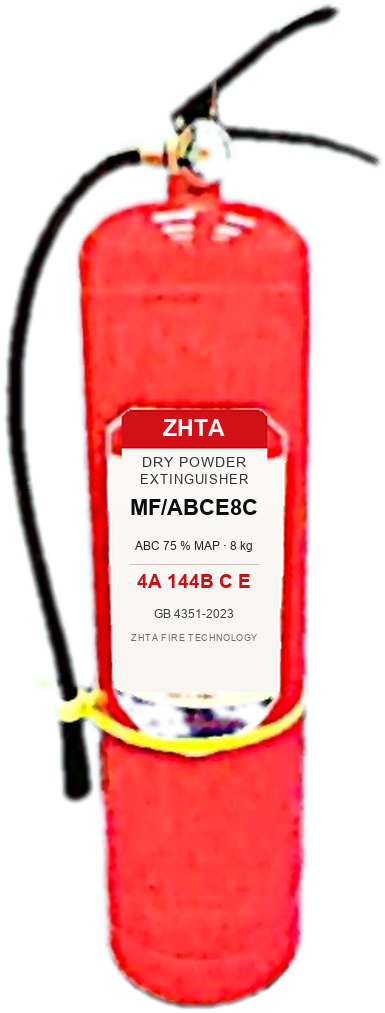
Portable dry powder extinguisher
Stored-pressure ABC extinguisher in seven sizes: 1, 2, 3, 4, 5 and 8 kg handheld plus a 35 kg wheeled unit. Nitrogen at 1.2 MPa drives 75 % monoammonium phosphate powder through a brass valve, and every model carries the E rating, so the same extinguisher is signed off for a workshop, a switch room and a fuel bay.
First response in workshops, warehouses, retail and offices, plant and boiler rooms, vehicle and engine bays, construction sites and fuel stores — the wheeled unit where the fire load needs 35 kg and a 6 m throw.
1 / 2 / 3 / 4 / 5 / 8 kg · 35 kg wheeled1A 21B … 10A 233B C EABC 75 % MAP−20 … +60 °C20–30 day lead timeODM / OEM
Seven sizes, one agent. 1, 2, 3, 4, 5 and 8 kg handheld plus a 35 kg wheeled unit — the same ABC 75 % monoammonium phosphate, the same −20 … +60 °C range and the same service procedure, so a site standardises on one powder and one refill stock.
Ratings that cover the hazard. From 1A 21B on the 1 kg to 4A 144B on the 8 kg and 10A 233B C E on the wheeled unit — every model is rated for class A solids, class B liquids, class C gas and energised electrical equipment.
Type-tested, not catalogue figures. Each size has its own CCCF type test to GB 4351-2023 (GB 8109-2023 for the wheeled unit): 20 °C spray performance, high and low temperature, impact, vibration, external corrosion, intermittent spray and a 5 %/year leak limit — all passed.
Discharge data you can quote. The 8 kg unit runs 20.2–23.2 s with a 4.5–4.6 m throw; the 35 kg unit 31.1 s and 6.2 m. Residual powder measured 2.5–6.2 %, inside the 10 % limit, so the stated charge actually leaves the container.
Standard, serviceable hardware. Brass valve with pressure indicator, PPE swirl nozzle, 1.4 MPa hose from 4 kg up (1.6 MPa on the wheeled unit), carbon steel body — every unit recharges from standard powder and a nitrogen charge, no proprietary cartridge.
Built to be knocked about. Bodies in DC01 carbon steel (HP295 on the 35 kg), tested after impact, vibration and salt spray, with a bracket for wall or vehicle mounting — the extinguisher that survives a workshop rather than a showroom.
20–30 days from order to a finished, filled and pressure-tested extinguisher — production, powder filling and the pressure test all inside that window. ODM / OEM supply available: your label and branding, agent grade, bracket, hose length and packaging.
Specifications
Model matrix — charge, rating, cylinder and measured performance
Model
Charge
Fire rating
Cylinder
Spray time
Throw
MF/ABCE1C
1 kg
1A 21B C E
1.25 L
8.3–8.6 s
3.2–3.3 m
MF/ABCE2C
2 kg
1A 21B C E
2.44 L
9.8–11.6 s
3.5 m
MF/ABCE3C
3 kg
2A 34B C E
3.66 L
13.2–13.6 s
3.5–3.6 m
MF/ABCE4C
4 kg
2A 55B C E
4.82 L
14.3–15.5 s
3.8–3.9 m
MF/ABCE5C
5 kg
3A 89B C E
6.10 L
14.0–15.6 s
3.9–4.1 m
MF/ABCE8C
8 kg
4A 144B C E
9.77 L
20.2–23.2 s
4.5–4.6 m
MFT/ABCE35
35 kg
10A 233B C E
42.2 L
31.1 s
6.2 m
Common specification — all seven models
Parameter
Value
Agent
ABC dry powder — NH4H2PO4 75 % + (NH4)2SO4 15 %
Propellant
Nitrogen ≥ 99.5 %, 1.2 MPa at 20 °C
Working temperature
−20 °C … +60 °C
Valve
Brass, with pressure indicator — FF75 / FF90 / FF110 (M24 / M30 × 1.5), FZT80 on the 35 kg
Nozzle / hose
PP nozzle (PPE from 4 kg) · hose 1.4 MPa, 1.6 MPa on the wheeled unit
Body
Carbon steel DC01 (HP295 on the 35 kg), red powder coat
Charge tolerance
−1.0 % … +2.0 % of nominal (measured)
Residual powder
2.5–6.2 % measured · limit 10 %
Leak rate
0.7 % per year measured · limit 5 % per year
Gross weight, 35 kg unit
56.5 ± 5 kg
Standards & test
GB 4351-2023 (handheld) · GB 8109-2023 (wheeled) · CNCA-C18-02:2024 · CCCF-CCC-III · type tests Gn202500717-01 … -07, Tianjin Fire Science and Technology Research Institute of MEM
Lead time
20–30 days including production and powder filling
Supply terms
ODM / OEM
Operation: pull the pin, aim at the base of the flame, squeeze and sweep. Service: check the gauge monthly, invert and shake the powder each quarter so it does not cake, recharge after any discharge and replace the unit at the end of its service life — the valve and hose are standard parts, so a refill does not need a factory return.
01GTYQ series
Gas detection · Combustible gas, point type
Point-type combustible gas detector
An explosion-proof point detector for combustible gas: a catalytic combustion sensor measures 3–100 %LEL and the reading goes out on RS485, CAN or a 4–20 mA loop, so the unit drops into a new loop or an existing controller without a converter. Address setting and calibration are done with an infrared remote — the flameproof housing is never opened in the hazardous area.
Petrochemical and city gas plant, boiler and utility rooms, gas cylinder stores, battery-charging rooms, paint and solvent areas, utility tunnels, cold stores, wastewater and incineration plant — anywhere a gas cloud forms before a fire does.
3–100 %LELRS485 / CAN / 4–20 mAEx db IIC T6 GbIP65 / IP67−40 … +70 °C30 day lead timeODM / OEM
Three outputs, one housing. RS485, CAN bus and a 4–20 mA current loop are all available, so the same detector serves a new addressable loop, a legacy controller or an analogue panel — no protocol converter and no second part number.
Commissioned without opening the cover. The address and the zero/span calibration are set over infrared remote control, so the flameproof joint is never broken in a live area — the one operation the certification does not allow.
Certified for gas and for dust. Ex db IIC T6 Gb for explosive gas atmospheres and Ex tb IIIC T80 °C Db for combustible dust, in a cast aluminium enclosure rated IP65 / IP67 — washdown and outdoor skids included.
Fast, stable measurement. Catalytic combustion sensing over 3–100 %LEL with ±3 %LEL resolution and under 50 s response; the sensor carries a 2-year life in clean air, and the detector reports Err1 when it reaches the end of it instead of drifting quietly.
Interlocks in the same unit. Built-in alarm and fault relay contacts (1 A @ 30 V DC) drive a sounder/beacon, a ventilation fan or a shut-off valve directly, and the high-brightness digital tube gives a reading at the wall without a laptop.
Rated for real plant rooms. −10 … +50 °C continuous and −40 … +70 °C occasional, storage to +70 °C, 0–95 % RH, and 1.5 W at 24 V DC so a long loop does not sag at the last detector.
Cast aluminium housingCatalytic combustion sensorInfrared remote setup4–20 mA / RS485 / CANAlarm & fault relaysEx db IIC T6 Gb
30 days from order to a finished, calibrated and aged unit — production, burn-in and calibration inside that window. ODM / OEM supply available: your branding, target gas and range, output protocol, cable-gland thread, bracket and packaging.
Specifications
GTYQ-ZHTA5212-C — point-type combustible gas detector
Parameter
GTYQ-ZHTA5212-C
Model
GTYQ-ZHTA5212-C (GT — industrial and commercial point-type combustible gas detector)
Detected gases
Methane, propane, isobutane, hydrogen
Detection principle
Catalytic combustion
Measuring range
3 % … 100 %LEL
Resolution
±3 %LEL
Response time
< 50 s
Sensor life
2 years in air — actual life depends on the operating environment
Power supply
DC 24 V · consumption ≤ 1.5 W
Output signal
RS485 / CAN bus / 4–20 mA current loop
Display
High-brightness digital tube
Alarm / fault output
Relay contacts, 1 A @ 30 V DC
Address setting
Infrared remote control — no cover opening
Protection rating
IP65 / IP67
Explosion protection
Ex db IIC T6 Gb · Ex tb IIIC T80 °C Db
Housing material
Cast aluminium
Electrical interface
NPT 3/4 · M20 × 1.5 · G 3/4
Weight
Approximately 1.1 kg
Operating temperature
−10 °C … +50 °C continuous · −40 °C … +70 °C occasional
Storage temperature
−40 °C … +70 °C
Operating humidity
0 … 95 % RH
Mounting
Wall, ceiling, vertical pipe or horizontal pipe (bracket supplied separately)
Installation: sensor facing down, cable entry sealed to the certified gland. Heavier-than-air gas — 0.3–0.6 m above the floor; lighter-than-air — within 2.0 m above the release source; slightly heavier or lighter — 0.5–1.0 m below or above the source. Ground the shield at one end only, warm up for at least 3 hours before calibration, and recalibrate annually.
Certification & test reports
TÜV Rheinland · English reports · full copies on request
Pass
EMC — Directive 2014/30/EU
Certificate of conformity plus the 26-page test report: conducted and radiated emission, radiated and conducted immunity, power-frequency field, EFT, surge and ESD on the finished detector.
CertificateAE 50744828 0001ReportCN268C1Z 001Tested toEN 50270 · EN IEC 61326-1Issued04 Sep 2026
Pass
RoHS — Directive 2011/65/EU
98 materials from the housing, PCBA, cable assembly and fixings screened for the ten restricted substances, including the four phthalates added by amendment (EU) 2015/863.
Report27233672a 001Materials tested98ScopeAnnex II + (EU) 2015/863Issued11 Sep 2026
Screened
REACH — Regulation (EC) 1907/2006
75 materials screened against the ECHA candidate list for substances of very high concern at article level. Where a substance is reported above 0.1 %, the report names it and the material it sits in.
Report numbers are quoted so a consultant can check them with the laboratory. Full English copies — 26 pages EMC, 17 pages RoHS, 17 pages REACH — go out with the datasheet.Request the reports
02ASD series
Gas detection · Aspirating smoke, early warning
Aspirating smoke detector
A laser optical air-sampling detector: the unit pulls air out of the protected space through a pipe network and reads it in a detection chamber, so it sees smoke long before it reaches a ceiling detector. Two models — ASD-ZHTA102 with one address point and two pipes, ASD-ZHTA204 with two address points and four pipes — and both run as a stand-alone system or as a loop device on another manufacturer's panel.
Cable voids, ceiling plenums, rack aisles, cold stores, heritage interiors, tobacco warehouses, base stations, unmanned plant rooms — the places where a point detector is either impractical or simply too late.
Laser scattering≈1000× point sensitivity2 / 4 pipes200 / 400 m pipe2,000 / 4,000 m²5 / 10 relays40,000 events30 day lead timeODM / OEM
Sees the fire hours earlier. A laser scattering chamber on a microprocessor-controlled air path gives roughly 1000× the sensitivity of a conventional point detector, so overheating, smouldering and the first aerosol release raise a pre-alarm while the fault is still a smell and a warm cable.
The pipe reaches what a ceiling detector cannot. Up to 200 m of pipe (2 × 100 m) on the 102 and 400 m (4 × 100 m) on the 204, with 42 / 84 sampling holes — cable voids, raised floors, plenums, rack tops, cold rooms, ducts and heritage ceilings, all sampled from one unit.
Two alarm stages before the fire alarm. Four levels — pre-alarm, action, fire 1 and fire 2 — plus fault, on five relays per address point rated 3 A at 30 V DC. The pre-alarm can start an investigation, stop a fan or close a damper long before anything is discharged.
Airflow and fault supervision, not just smoke. The aspirator measures flow continuously against a learned baseline, so a crushed, blocked or disconnected pipe is reported as a fault instead of becoming a silent blind spot; pump speed is adjustable for long or dirty runs.
Commissioned from the front, no laptop. Touch keys and the LCD show smoke level, airflow, temperature and pump speed; address, thresholds, delays and sensitivity are set locally or over RS485 from a PC, and the unit self-learns its pipe after twenty minutes of running.
40,000 events in a metal housing. The log keeps 40,000+ fire, fault and setting events for a post-incident review. Metal enclosure, −10 … +55 °C, replaceable filter cartridge, optional remote display for a guard house or lobby.
Laser scattering chamber2 or 4 pipes200 / 400 m pipe run42 / 84 sampling holes5 / 10 relaysRS485Metal housing
30 days from order to a tested, calibrated and aged unit — pipe network layout and calculation inside that window. ODM / OEM supply available: your branding, pipe layout and sampling-hole scheme, relay logic, remote display, labelling and packaging.
Real-time airflow, dynamic fault monitoring, self-learning on start-up
Pump speed
Adjustable
Remote display
Optional
Power supply
DC 24 V (−15 % / +10 %)
Max current
1 A
1.5 A
Fuse
2 A
Ambient temperature
−10 … +55 °C
Dimensions
295 × 220 × 97 mm
Weight
2.55 kg
3.15 kg
Power unit
ZHTADY2410 · AC 220 V · DC 24 V 5.5 A · 12 V / 14 Ah × 2 back-up · 350 × 240 × 130 mm · 10.8 kg
Standard
GB 15631-2008
Approval
CCCF 2026081801000774 · valid to 26 May 2031
Test reports
Dz2025104541 · Dz2025104542
Lead time
30 days including production and calibration
Supply terms
ODM / OEM
Pipework: Ø25 mm OD (21 mm ID) tube, 21 sampling holes per run — 20 at Ø2 mm plus one Ø5 mm at the far end — maximum 8 bends, each up to 180° with a 100 mm radius. Run the aspirator for twenty minutes, then let the unit self-learn the airflow before trimming the thresholds. Change the internal filter every 6–12 months in dusty spaces, fit the external filter at the inlet where the air is dirty, and mask any hole you do not use.
An S-type condensed aerosol device in a stainless canister: initiator, aerosol-forming agent, cooling path, feedback element and housing in one sealed body, with nothing stored under pressure. On a start signal the agent is activated and the generator discharges a large volume of aerosol that floods the whole enclosure — no cylinder valve, no manifold, no pipework and no nozzle network to design.
Mounted where the fire risk is: energy storage, wind power, power generation and distribution, transmission and distribution equipment, utility tunnels and cable galleries, equipment rooms and cabinets — the small 0.1 kg unit for a single cabinet, the 0.3 kg unit for a room of up to 3 m³.
0.1 / 0.2 / 0.3 kg≤1 / 2 / 3 m³ protected≤6 / 8 / 10 s discharge175 ± 15 °C thermal + 24 V electricXF 499.1-2010−50 … +95 °C30-day lead timeODM / OEM
Small and stored without pressure. The agent sits solid in a sealed stainless canister at atmospheric pressure, so there is no cylinder valve, no pressure gauge, no manifold and no pipework — a bracket and two screws hold the whole device, and the installed cost is a fraction of a piped system.
Fast total flooding of the whole volume. Discharge is ≤6 s on the 0.1 kg unit, ≤8 s on the 0.2 kg and ≤10 s on the 0.3 kg, at a design density of 100 g/m³ — the aerosol behaves as a gas, so it reaches cabinet interiors, cable trays and ceiling voids that a nozzle jet would miss.
Thermal or electric release, dual control. A 175 ± 15 °C heat-sensitive cord fires the device on its own when the zone overheats, or the panel releases it electrically at 24 V DC (≥0.7 A for ≥50 ms). A volt-free contact reports the release, so the device can be supervised like any other detector circuit.
Almost nothing to maintain. In service the only check is the condition of the heat-sensitive cord — the device itself is maintenance-free within its validity. Every unit ships with manual, certificate and factory test report, so commissioning paperwork is complete on arrival.
Clean on the equipment it protects. The aerosol is non-conductive, non-toxic and non-corrosive and depletes no ozone; the residue is a dry micro-powder that is vacuumed off, with no water, foam or acid breakdown product left on terminals and PCBs.
Built for plant conditions. Rated −50 °C … +95 °C and ≤95 % RH with a housing surface temperature ≤200 °C at discharge, on an S-type agent of strontium nitrate 50–55 % and potassium nitrate 10–15 % to XF 499.1-2010 — the temperature band covers outdoor cabinets, cold stores and hot plant rooms alike.
Stainless canisterInitiator + cooling pathHeat-sensitive cord 0.45 m24 V electric actuatorVolt-free feedbackM4 / M5 bracket, 2–5 N·m
30 days from order to a finished, filled and tested device. ODM / OEM supply available — your label, charge size, cord and cable length, bracket and packaging.
Specifications
QRR series — S-type condensed aerosol, 0.1–0.3 kg
Parameter
QRR0.1G/S
QRR0.2G/S
QRR0.3G/S
Model
QRR0.1G/S-ZHTA
QRR0.2G/S-ZHTA
QRR0.3G/S-ZHTA
Agent charge
0.1 kg
0.2 kg
0.3 kg
Dimensions (Φ × H)
Φ75 × 160 mm (± 2 mm)
Φ75 × 160 mm (± 2 mm)
Φ127 × 150 mm (± 2 mm)
Protected volume
≤ 1 m³
≤ 2 m³
≤ 3 m³
Discharge time
≤ 6 s
≤ 8 s
≤ 10 s
Nozzle thermal clearance 400 / 200 / 75 °C
≤ 0.1 / 0.3 / 0.5 m
≤ 0.3 / 0.5 / 0.8 m
≤ 0.3 / 0.5 / 0.8 m
Extinguishing density
100 g/m³
Activation
Thermal + electric, dual control (24 V DC, ≥ 0.7 A for ≥ 50 ms)
Device · manual · certificate of conformity · factory test report
Lead time
30 days including production and agent filling
Supply terms
ODM / OEM
Release sequence: heat-sensitive cord or detector trips → panel confirms and releases the 24 V start signal → the initiator activates the aerosol-forming agent → the aerosol passes the cooling path and leaves the outlet → the enclosure is flooded in ≤ 6–10 s → the volt-free contact reports the release and the fired device is replaced.
Seven charges on one platform — 0.01, 0.02, 0.04, 0.1, 0.144, 0.15 and 0.3 kg — in sealed flat housings 16 to 32 mm thick. Initiator, aerosol-forming agent, cooling path, feedback element and housing sit in one body that stores nothing under pressure, so the unit is a screw-fixed box on the wall of a cabinet or under a ceiling, not a cylinder with a valve and a pipe run.
Sized to the enclosure rather than to the room: 0.01 kg for a control box or a small terminal compartment, up to 0.3 kg for a room of 3 m³ — switchgear and battery cabinets, cable trays and tunnels, false ceilings, small unmanned compartments, energy storage and wind power equipment.
0.01 – 0.3 kg≤0.1 – 3 m³≤6 s discharge175 ± 15 °C + 24 VXF 499.1-2010−45 … +80 °C20–30 day lead timeODM / OEM
Seven charges, one platform. From 0.01 kg for a single control box to 0.3 kg for a 3 m³ room, the family covers 0.1 to 3 m³ in one design language — upsize the hazard and you change the unit, not the mounting, the wiring or the approval file.
Flat enough to fit where a cylinder cannot. Bodies are 16–32 mm thick and 45 to 204 mm wide, so a unit sits inside a switchgear cabinet, on a cable tray wall or above a false ceiling — the places where a fire actually starts and where a cylinder bank has nowhere to stand.
Nothing stored under pressure. The agent is solid at atmospheric pressure: no cylinder valve, no pressure gauge, no manifold and no pipework to route — one bracket and a few screws hold the whole device, and there is no slow leak to chase and no re-pressurisation to schedule.
Release matched to the hazard. The 0.01 and 0.02 kg units are heat-only — a 175 ± 15 °C cord and nothing else, so they work with no power at all. From 0.04 kg up the unit is thermal and electric: 24 V DC at ≥0.7 A for ≥50 ms from the panel, or the cord on its own, with a volt-free contact reporting the release.
Fast total flooding from a small box. Discharge is complete in ≤6 s at a design density of 100 g/m³; the aerosol behaves as a gas, so it reaches the inside of a cabinet, the back of a terminal row and the void above a ceiling that a nozzle jet would miss.
Clean on the equipment, cheap to keep. Non-conductive, non-toxic, non-corrosive and no ozone depletion; the residue is a dry micro-powder that is vacuumed off, and the housing stays ≤200 °C. In service the only check is the heat-sensitive cord — the device itself is maintenance-free within its validity.
0.01 – 0.3 kg charges16 – 32 mm thickHeat cord 0.45 m24 V electric from 0.04 kgVolt-free feedbackXF 499.1-2010
20–30 days from order to a finished, filled and factory-tested unit. ODM / OEM supply available — your label, charge size, cord and cable length, bracket and packaging.
Specifications
QRR series — S-type condensed aerosol, 0.01–0.3 kg
Model
Size W × H × D
Protected volume
Discharge
Start current
Clearance 400/200/75 °C
QRR0.01G/S-ZHTA
45 × 45 × 18 mm (±1)
≤ 0.1 m³
≤ 6 s
heat only
≤ 0.1 / 0.2 / 0.3 m
QRR0.02G/S-ZHTA
60 × 60 × 18 mm (±1)
≤ 0.2 m³
≤ 6 s
heat only
≤ 0.1 / 0.2 / 0.3 m
QRR0.04G/S-ZHTA
114 × 80 × 25 mm (±2)
≤ 0.4 m³
≤ 6 s
≥ 0.7 A
≤ 0.3 / 0.5 / 0.8 m
QRR0.1G/S-ZHTA
144 × 100 × 30 mm (±2)
≤ 1 m³
≤ 6 s
≥ 0.7 A
≤ 0.1 / 0.3 / 0.5 m
QRR0.144G/S-ZHTA
155 × 104 × 16 mm (±2)
≤ 1.4 m³
≤ 6 s
≥ 0.7 A
≤ 0.3 / 0.5 / 0.8 m
QRR0.15G/S-ZHTA
164 × 140 × 30 mm (±2)
≤ 2 m³
≤ 6 s
≥ 0.7 A
≤ 0.3 / 0.5 / 0.8 m
QRR0.3G/S-ZHTA
204 × 160 × 32 mm (±2)
≤ 3 m³
≤ 6 s
≥ 0.7 A
≤ 0.3 / 0.5 / 0.8 m
Common to the series
Parameter
QRR series
Activation
0.01 / 0.02 kg: heat only · 0.04–0.3 kg: thermal + electric, dual control
Device · manual · certificate of conformity · factory test report
Lead time
20–30 days including production and agent filling
Supply terms
ODM / OEM
Mounting: fix the body on its bracket with the outlet pointing at the hazard, keep the nozzle clearances above, then lay the heat-sensitive cord in an S across the fire-risk area clear of live parts and wire to the terminal markings. Do not install in damp or chemically aggressive atmospheres; the outlet must never face personnel; after a release let the housing cool before touching it, and replace the fired unit.
An S-type condensed aerosol generator built as a single round wall-mounted unit: a Ø235 mm body carried on a 350 mm mounting plate, with the initiator, aerosol-forming agent, cooling path, feedback element and housing sealed into one body that stores nothing under pressure. One device protects up to 30 m³ — a room that would otherwise need a cylinder, a manifold and a nozzle grid.
Specified for energy storage, wind power, power generation and substations, transmission and distribution rooms, and utility tunnels and cable galleries — wherever a large single volume has to be covered without pipework.
3 kg agent≤30 m³ protected≤60 s discharge175 ± 15 °C + 24 V ≥2 AEN 15276-1 · XF 499.1-2010−45 … +80 °C20–30 day lead timeODM / OEM
One unit covers a whole room. A single 3 kg generator protects up to 30 m³ at a design density of 100 g/m³, so a battery room, a wind nacelle, a switchgear room or a cable gallery needs one bracket instead of a cylinder bank, a manifold and a nozzle layout — fewer components, less design work, lower installed cost.
Small and stored without pressure. The agent sits solid inside a sealed housing at atmospheric pressure: no cylinder valve, no pressure gauge, no pipework, nothing to leak. The wall bracket is fixed with four M8 stainless screws at 8–11 N·m and the device is complete on the wall.
Thermal or electric release, dual control. The 175 ± 15 °C heat-sensitive cord fires the device on its own when the zone overheats, or the panel releases it electrically at 24 V DC (≥2 A for ≥50 ms). A volt-free feedback element reports the release back to the panel, so the unit is supervised like any other detector circuit.
Total flooding, not a jet. The aerosol behaves as a gas: it leaves the outlet in ≤60 s and fills the whole enclosure, reaching cabinet interiors, cable trays, ceiling voids and corners that a nozzle jet would miss — no dead zones to argue about at commissioning.
Clean on the equipment it protects. Non-conductive, non-toxic, non-corrosive and no ozone depletion; the residue is a dry micro-powder that is vacuumed off, leaving no water, foam or acid breakdown product on terminals, busbars and PCBs. Housing surface stays ≤200 °C at discharge.
Built for plant conditions, cheap to keep. Rated −45 … +80 °C and ≤95 % RH with an S-type agent of strontium nitrate 50–55 % and potassium nitrate 10–15 %; in service the only check is the condition of the heat-sensitive cord, and the device itself is maintenance-free within its validity. Complies with both EN 15276-1 and XF 499.1-2010.
Round Ø235 mm body350 mm wall bracketFour Ø9 mm fixing holesM8 stainless, 8–11 N·mHeat-sensitive cord 0.45 mVolt-free feedback
20–30 days from order to a finished, filled and factory-tested unit. ODM / OEM supply available — your label, charge size, cord and cable length, bracket and packaging.
Specifications
QRR3G/S-ZHTA-E — S-type condensed aerosol, 3 kg
Parameter
QRR3G/S-ZHTA-E
Model
QRR3G/S-ZHTA-E
Agent charge
3 kg
Overall dimensions (W × H × D)
350 × 285 × 151 mm (± 5 mm)
Body diameter
Ø235 ± 5 mm
Mounting plate
350 × 150 mm, hole pitch 330 ± 2 mm / 90 ± 2 mm, 4 × Ø9 mm holes
0.45 ± 0.05 m, laid in an S along the fire-risk area
Mounting
M8 stainless screws, 8–11 N·m
Standards
EN 15276-1 · XF 499.1-2010
Scope of supply
Device · manual · certificate of conformity · factory test report
Maintenance
Cord condition check only; device maintenance-free within its validity
Lead time
20–30 days including production and agent filling
Supply terms
ODM / OEM
Installation: fix the bracket on the four Ø9 mm holes at 330 × 90 mm centres with M8 stainless screws at 8–11 N·m, lay the heat-sensitive cord in an S across the fire-risk area clear of live parts, then wire to the terminal markings. Do not install in damp or chemically aggressive atmospheres; the outlet must never face personnel; after a release let the housing cool before touching it, and replace the fired unit.
01MZ-F/W series
CE · Detection tube · FK-5-1-1 · No power required
Detection tube unit
A sealed polymer tube filled with FK-5-1-1, run along the inside of the cabinet it protects. The point of the tube that sees the fire first softens and bursts at 110 °C, and the agent leaves through that same hole straight into the burning zone — there is no detector to poll, no panel to program and no electrical supply at all.
The -E version is the export build: same tube and same 1.6 MPa charge, supplied with the EU declaration of conformity, the EMC test report to the harmonised standards and the RoHS / REACH material declaration for the EU consultant to file.
750 g FK-5-1-1≤1 m³ per unit≤8 s dischargeBursts at 110 ± 10 °CCE · EMC · RoHS · REACH20–30 day lead timeODM / OEM
It works with the power off. The tube is the detector and the release at once, so a unit inside a de-energised cabinet, a battery rack or a container that has been isolated for maintenance still fires. Nothing in the chain depends on a 24 V loop staying alive.
Discharge where the fire is. Only the section that bursts opens, so the agent leaves at the hot spot instead of flooding from a remote nozzle — a small enclosure is knocked down in seconds and the rest of the tube stays intact.
Follows the shape of the equipment. φ18 mm tube bends to a 200 mm radius and is supplied in 3 m lengths, φ30 mm in 1.2 m, so it threads through a rack, around a busbar or across the inside of a cabinet door without brackets or pipework.
Reports that it fired. A pressure switch on the tube closes a dry, normally-open contact, which the panel or the BMS reads as a release — the same signal an addressed detector would give, wired to a single pair.
Nothing to service between releases. No gauge to watch, no cylinder to weigh, no sensor to recalibrate: the annual check is a visual inspection of the tube for kinks and mechanical damage. The agent is non-conductive and leaves no residue on terminals.
The CE file is already written. EMC to EN IEC 61000-6-3:2021 and EN 50130-4:2011+A1 under 2014/30/EU, with the RoHS 2011/65/EU and REACH (EC) No. 1907/2006 declarations issued for the exact model shipped.
20–30 days from order to a filled, pressurised and tested unit. ODM / OEM supply available — your label, tube length, end fittings, pressure-switch setting and packaging.
Specifications
MZ-F/W-*/1.6-ZHTA-E — detection tube unit, CE
Parameter
Value
Model
MZ-F/W-*/1.6-ZHTA-E (φ18 / φ30)
Agent
FK-5-1-1 (perfluorohexanone)
Agent charge
750 g
Tube size
φ18 × 14 mm, 3,000 ± 5 mm · φ30 × 25 mm, 1,200 ± 5 mm
Storage pressure
1.6 MPa at 20 °C
Burst temperature
110 ± 10 °C, at the hottest point of the tube
Protected volume
≤1 m³ per unit
Discharge time
≤8 s
Release feedback
Dry contact, normally open (pressure switch)
Operating temperature
−40 °C … +80 °C
Installation
Top of the protected object or the fire-prone area; minimum bend radius R200 mm
CE — EMC
2014/30/EU · EN IEC 61000-6-3:2021 · EN 50130-4:2011+A1 · TÜV Rheinland certificate
CE — materials
RoHS 2011/65/EU · REACH (EC) No. 1907/2006
Product standard
Q/ZHTA 09-2023 · type-tested to XF 499.1-2010 (report FH2024QC0018)
Lead time
20–30 days including production and filling
Supply terms
ODM / OEM
Install with the tube in contact with the highest-risk surface inside the enclosure, clipped every 300–500 mm and clear of sharp edges and moving parts; do not paint over it and do not splice it. After a release the whole tube is replaced — it is a one-shot device, and the remaining agent is discharged during removal, so ventilate the space first.
02GTYQ series
CE · ATEX · Point-type combustible gas detector · IP65
Combustible gas detector
A catalytic-combustion point detector for methane, propane, isobutane and hydrogen, in a cast-aluminium Ex db housing with a four-digit display you can read through the window. It sits on the wall, the ceiling or a pipe in a battery room, a gas yard or a boiler house and puts 3–100 %LEL on a 4–20 mA loop, an RS485 bus or CAN.
For the EU the unit carries ATEX to EN 60079-0 / -1 / -31 and EMC to EN 50270 and the EN IEC 61326 series, with the address set by infrared remote so nobody opens the cover in a hazardous area.
3–100 %LELCatalytic combustion<50 s responseEx db IIC T6 GbIP65 / IP67CE · ATEX · RoHS · REACH20–30 day lead timeODM / OEM
Three outputs from one device. 4–20 mA, RS485 and CAN are all on the terminal block, so the detector can drop into an existing analogue loop, a Modbus segment or a CAN network without a gateway in between.
Set the address without opening the cover. Infrared remote configuration keeps the flameproof joint closed in service — the one operation that normally breaks an Ex certification on site simply does not happen.
Readable in the dark. The high-brightness digital tube shows %LEL through the window, so an operator walking the room sees the reading before the panel alarms.
Built for both gas and dust. Ex db IIC T6 Gb for gas and Ex tb IIIC T80 °C Db for dust in the same housing, IP65 or IP67 — one model covers a battery room that also has carbon dust in the air.
Calibrated before it ships. Every unit leaves with a calibration certificate; the sensor is socketed, so a two-year replacement in the field is a sensor swap, not a new detector.
A CE file with a certificate number. EMC Directive 2014/30/EU under TÜV Rheinland registration AE 50744828 0001, plus RoHS 2011/65/EU and REACH SVHC screening — the references an EU consultant asks for by name.
DC 24 V · ≤1.5 WRS485 / CAN / 4–20 mARelay 1 A @ 30 V DCInfrared addressingNPT 3/4 · M20 · G 3/41.1 kg
20–30 days from order to a calibrated, certified detector. ODM / OEM supply available — your label, gas range, output protocol, cable gland and packaging.
Specifications
GTYQ-ZHTA5212-C — point-type combustible gas detector, CE / ATEX
Parameter
Value
Model
GTYQ-ZHTA5212-C
Detected gases
Methane, propane, isobutane, hydrogen
Detection principle
Catalytic combustion
Measuring range
3 … 100 %LEL
Resolution
±3 %LEL
Response time
<50 s
Sensor life
2 years in air — actual life depends on the operating environment
Power supply
DC 24 V · consumption ≤1.5 W
Output signal
RS485 / CAN bus / 4–20 mA current loop
Display
High-brightness digital tube
Alarm / fault output
Relay contacts, 1 A @ 30 V DC
Address setting
Infrared remote control — no cover opening
Protection rating
IP65 / IP67
Explosion protection
Ex db IIC T6 Gb · Ex tb IIIC T80 °C Db
Housing material
Cast aluminium
Electrical interface
NPT 3/4 · M20 × 1.5 · G 3/4
Weight
Approximately 1.1 kg
Operating temperature
−10 °C … +50 °C continuous · −40 °C … +70 °C occasional
Storage temperature
−40 °C … +70 °C
Operating humidity
0 … 95 % RH
Mounting
Wall, ceiling, vertical pipe or horizontal pipe (bracket supplied separately)
CE — EMC
2014/30/EU · EN 50270:2015 · EN IEC 61326-1:2021 · EN IEC 61000-6-1/2/3/4 · TÜV Rheinland AE 50744828 0001
Mount at the height the gas dictates — methane and hydrogen rise, so the detector goes high or on the ceiling; propane and isobutane are heavier than air and go low, within 300 mm of the floor. Calibrate with the certified gas mixture at commissioning and re-check at the interval the site permit requires; the display and the 4–20 mA loop can be checked without opening the housing.
03ZHTA-3000-ET
CE · Condensed aerosol · Round body · 3 kg
Round aerosol generator
A 3,000 g charge sealed in a round red housing on a wall bracket. On release the solid charge converts to aerosol and floods the enclosure — 30 m³ at the 100 g/m³ design density — in under ten seconds, reaching the inside of cabinets and the void above a ceiling that a nozzle jet would miss. Nothing in the body is stored under pressure, so there is no cylinder valve, no manifold and no pipe run to design.
The CE build is certified to BS EN 15276-1:2019 and carries the TÜV certificate on the body, with EMC to EN IEC 61000-6-3:2021 and EN 50130-4:2011+A1 and RoHS to EU 2015/863. Fifteen-year service life, Class A, B and C fires.
3,000 g charge≤30 m³ protected≤10 s dischargeBS EN 15276-1:2019Class A / B / C15-year lifeCE · EMC · RoHSODM / OEM
One body, one room. A single 3 kg generator covers 30 m³ — a battery room, a switchgear room, a cable gallery or a small plant room — so the installation is one bracket and four bolts instead of a cylinder bank, a manifold and a nozzle grid.
The certificate is on the device. The rating plate carries the TÜV mark and the CE / RoHS marks next to the model and the batch, so an inspector reads the conformity off the hardware rather than chasing a folder.
Tested to the product standard, not a generic one. BS EN 15276-1:2019 is the condensed aerosol device standard; the discharge time, the flow temperature and the clearance distances on this page are the values the test house measured, not catalogue rounding.
Thermal or electric release. A heat-sensitive cord rated 185 ± 15 °C fires the unit with no power at all, or the panel releases it at 24 V DC; a volt-free contact reports the release so the unit is supervised like a detector circuit.
Clearances you can design to. The minimum gaps to a 400 °C, 200 °C and 75 °C surface are 0.4 m, 0.7 m and 0.9 m — published numbers, so the layout is drawn once and passes on site.
Nothing to leak between releases. The agent is solid at atmospheric pressure: no gauge to watch, no weight to log, no re-pressurisation. In service the only check is the condition of the heat-sensitive cord.
20–30 days from order to a filled, sealed and factory-tested unit. ODM / OEM supply available — your label, charge size, bracket, cord length and packaging.
Specifications
ZHTA-3000-ET — hot aerosol extinguishing device, CE
Parameter
Value
Model
ZHTA-3000-ET
Type
Condensed aerosol, solid charge, stored at atmospheric pressure
Mass of aerosol-forming compound
3,000 g
Protected volume
≤30 m³ at 100 g/m³ design density
Effective discharge time
≤10 s
Aerosol flow temperature
400 °C / 200 °C / 75 °C
Minimum thermal clearance
0.4 m / 0.7 m / 0.9 m to the 400 / 200 / 75 °C surfaces
Fire classes
A · B · C
Activation
Heat-sensitive cord 185 ± 15 °C · electric 24 V DC, ≥0.7 A for ≥50 ms
Release feedback
Volt-free contact
Operating temperature
−45 °C … +90 °C
Storage humidity
≤95 % RH
Useful life
15 years
Product standard
BS EN 15276-1:2019
CE — EMC
EN IEC 61000-6-3:2021 · EN 50130-4:2011+A1
CE — materials
RoHS (EU 2015/863)
Marking
Model, batch, date of manufacture and serial number on the rating plate
Lead time
20–30 days including production and filling
Supply terms
ODM / OEM
Fix the bracket with the outlet facing the volume, keep the clearances above to any surface that stays hot, and lay the heat-sensitive cord in an S across the risk area, clear of live parts. The outlet must never face personnel: the aerosol leaves the body hot enough to burn skin, and the housing stays hot for several minutes after a release — ventilate and let it cool before handling, then replace the fired unit rather than re-using the body.
04ZHTA-500/1000-ET
CE · Condensed aerosol · Cylindrical body · 0.5 and 1 kg
Cylindrical aerosol generator
The same aerosol chemistry in a stainless canister, for the smaller volumes where a round 3 kg body is more than the room needs. The 500 g unit protects up to 5 m³ and the 1,000 g unit up to 10 m³ — a single cabinet, a control panel, a container corner or a small store — and both mount vertically on a wall or inside the enclosure.
Certified to the same standard as the round body, BS EN 15276-1:2019, with EMC to EN IEC 61000-6-3:2021 and EN 50130-4:2011+A1, RoHS to EU 2015/863 and the same fifteen-year service life. Both sizes are in production now; the CE certificate for the canister build is in progress, and the declaration is issued against the test file as it lands.
500 g / 1,000 g≤5 m³ / ≤10 m³≤10 s dischargeBS EN 15276-1:2019Class A / B / C15-year life20–30 day lead timeODM / OEM
Sized to the box, not the room. 500 g for 5 m³ and 1 kg for 10 m³ means a cabinet or a small compartment gets the right charge instead of an oversized unit and a clearance problem against the wall.
Stainless body, no pressure. The canister is a sealed shell at atmospheric pressure: no valve, no gauge, no manifold, no pipework. Two brackets and four screws, and the device is installed.
Vertical mount, small footprint. The canister stands on a wall bracket inside the enclosure or beside it, so a container corner or a cable shaft that has no ceiling space still takes a unit.
Same file as the round body. One standard, one set of discharge and clearance figures, one EMC report — a project that mixes round and cylindrical units submits a single conformity document.
Thermal or electric release. Heat-sensitive cord at 185 ± 15 °C, or 24 V DC from the panel, with a volt-free contact back to the panel in both cases.
Fifteen years, then replace. The charge is stable for the stated service life with no maintenance inside it — the annual check is a visual inspection of the cord and the body.
20–30 days from order to a filled, sealed and factory-tested unit. ODM / OEM supply available — your label, charge size, bracket, cord length and packaging.
Specifications
ZHTA-500-ET / ZHTA-1000-ET — hot aerosol extinguishing device, cylindrical
Parameter
ZHTA-500-ET
ZHTA-1000-ET
Mass of aerosol-forming compound
500 g
1,000 g
Protected volume
≤5 m³
≤10 m³
Effective discharge time
≤10 s
≤10 s
Aerosol flow temperature
400 °C / 200 °C / 75 °C
Minimum thermal clearance
0.4 m / 0.7 m / 0.9 m
Fire classes
A · B · C
Body
Stainless canister, vertical wall bracket
Activation
Heat-sensitive cord 185 ± 15 °C · electric 24 V DC, ≥0.7 A for ≥50 ms
Release feedback
Volt-free contact
Operating temperature
−45 °C … +90 °C
Storage humidity
≤95 % RH
Useful life
15 years
Product standard
BS EN 15276-1:2019
CE — EMC
EN IEC 61000-6-3:2021 · EN 50130-4:2011+A1
CE — materials
RoHS (EU 2015/863)
Dimensions
Per drawing — three shell sizes cover the range
Lead time
20–30 days including production and filling
Supply terms
ODM / OEM
Stand the canister upright with the outlet clear of the wall and of any cable that runs past it, and respect the 0.4 / 0.7 / 0.9 m clearances to surfaces that stay hot after a release. Route the heat-sensitive cord across the top of the enclosure, where smoke and heat collect first, and keep it off live terminals. Replace the whole unit after a release.
05YF series
CE · Prefabricated · FK-5-1-1 · No site pipework
Prefab FK-5-1-1 unit
A prefabricated clean-agent unit: the FK-5-1-1 charge, the release and the outlet arrive in one extruded aluminium body that is charged, sealed and tested in the factory. On site there is nothing to pressure-test, no pipe to cut and no nozzle to position — the body is fixed to the equipment it protects and the flying leads are connected.
It is the answer for a cabinet, a machine enclosure or a small compartment where a piped FK-5-1-1 system would cost more in labour than the equipment is worth, but where the project still needs a CE-marked device with an EMC test report rather than an uncertified can.
FK-5-1-1Factory chargedNo pipeworkExtruded aluminium bodyCE · EMC · RoHS20–30 day lead timeODM / OEM
Commissioning is a mounting job. The unit arrives charged, sealed and pressure-tested, so the site work is two fixings and a plug — no nitrogen kit, no manifold, no pressure hold test and no commissioning engineer on the second visit.
Clean agent, no clean-up bill. FK-5-1-1 is non-conductive, leaves no residue and has no ozone depletion potential, so a release does not take the equipment out of service the way a powder or water system does.
A body that fits the equipment. The extruded section is long and slim, so it sits along the top of a cabinet or inside a machine frame instead of standing on the floor like a cylinder.
One device, one certificate. Each unit carries its own CE declaration and the EMC report to EN IEC 61000-6-3:2021 and EN 50130-4:2011+A1 — a repeat-build project files the same document for every unit instead of re-testing a bespoke assembly.
Repeatable for OEM lines. Because the body is prefabricated, unit twenty is identical to unit one — the reason machine builders specify it for a production line rather than a site-built system.
20–30 days from order to a charged, sealed and tested unit. ODM / OEM supply available — your label, body length, charge size, connector and packaging.
Specifications
YF*Q-ZHTA — prefabricated perfluorohexanone unit, CE
Parameter
Value
Model
YF*Q-ZHTA
Type
Prefabricated, factory-charged and sealed — no site pipework
Agent
FK-5-1-1 (perfluorohexanone)
Construction
Extruded aluminium body, end caps, flying leads and plug-in connector
Mounting
Direct on the protected equipment or its enclosure
CE — EMC
2014/30/EU · EN IEC 61000-6-3:2021 · EN 50130-4:2011+A1
CE — materials
RoHS (EU 2015/863)
Charge and dimensions
Per model — confirmed against the drawing for your enclosure
Lead time
20–30 days including production and filling
Supply terms
ODM / OEM
Fix the body along the top of the enclosure with the outlet pointing into the free volume, not against a wall or a bundle of cables, and leave the connector accessible for the annual check. The cylinder is replaced as a sealed unit after a release; do not attempt to recharge the body on site.
06JTY series
CE · Energy storage · Composite detector · Three-state indication
Composite fire detector
A composite detector built for the inside of an energy-storage enclosure: more than one fire criterion is evaluated in a single housing, so the unit can tell a real cell event from the dust, humidity swing and electromagnetic noise that fill a battery container, and it reports the result on a three-lamp face — normal, malfunction, alarm.
For the EU the detector is declared under EMC to EN 61326, electrical safety to EN 61010 and RoHS to EU 2015/863, with the TÜV test reports filed per model. The compact body fixes to a bracket on the rack face or the container wall, inside the protected volume rather than in the corridor outside it.
Composite criteriaNormal / fault / alarm LEDsEN 61326 EMCEN 61010 safetyRoHS (EU 2015/863)20–30 day lead timeODM / OEM
Fewer false trips in a battery container. More than one criterion has to agree before the detector alarms, which is what keeps a container full of dust, condensation and inverter noise from shutting down the plant on a single sensor spike.
Status you can read standing in front of it. Normal, malfunction and alarm each have their own lamp, so a technician knows whether the detector is healthy before opening a laptop or a panel.
Declared for the EU on three fronts. EMC to EN 61326, electrical safety to EN 61010 and RoHS to EU 2015/863 — the three documents an ESS integrator is asked for, and the three that a generic Asian detector usually cannot produce.
Small enough to sit inside the rack. The body mounts on a bracket inside the enclosure, close to the cells it watches, instead of sampling the room from the wall outside.
Built for the container environment. The housing is closed and the electronics are screened for the switching noise an inverter and a BMS put into the same cabinet.
20–30 days from order to a tested, calibrated detector. ODM / OEM supply available — your label, cable length, output protocol and packaging.
Specifications
JTY-ZHTA*-C — composite fire detector for energy storage, CE
Parameter
Value
Model
JTY-ZHTA*-C
Application
Composite fire detector for energy storage power stations — inside the rack or the container
Detection
Composite — more than one fire criterion evaluated in one housing
Indication
Normal · malfunction · alarm, one lamp each
Housing
Closed moulded body with mounting ears, cable entry on the side
Mounting
Bracket on the rack face or the container wall, inside the protected volume
CE — EMC
EN 61326
CE — safety
EN 61010 (electrical safety)
CE — materials
RoHS (EU 2015/863)
Electrical data
Supply, output and threshold data per model — confirmed against the drawing for your project
Lead time
20–30 days including production and test
Supply terms
ODM / OEM
Mount the detector above the cell modules, where a venting cell releases its gas, and keep it clear of the cooling-air path so that dust is not driven straight into the sensing chamber. Do not paint the face: the three indicator lamps are the field check, and a coat of paint over them turns the annual inspection into a removal job.
07ZH-400350 series
CE · ATEX · Explosion-proof wall fan · IP66
Explosion-proof wall fan
A wall-mounted axial fan for a container or a battery room that has to be vented without making the enclosure itself a source of ignition. The motor is Ex ec rated and the whole assembly is IP66, so it mounts in the wall opening of a hazardous area and moves air through a louvre that closes when the fan stops.
Two builds: the CP exhaust unit at AC 220 V moves 1,313 m³/h against 26 mmH₂O, and the CJ intake unit at DC 24 V pulls make-up air in. Both are ATEX to EN 60079-0 and EN 60079-7, carry the CE mark, and are supplied in RAL7035 with C3, C4 or C5 corrosion protection for coastal and offshore sites.
1,313 m³/h exhaustEx ec IIC T4 / T6IP66EN 60079-0 · EN 60079-7C3 / C4 / C520–30 day lead timeODM / OEM
Vent a hazardous area without a second enclosure. The motor is Ex ec for the gas group and temperature class of the space, so the fan is part of the Ex installation rather than something the consultant has to argue about.
A real air change, not a token one. 1,313 m³/h at 26 mmH₂O clears a 20-foot container in minutes, which is what a gas-detection trip needs to bring the concentration down before anyone opens the door.
Closes when it stops. The shutter drops shut with the fan, so the wall opening does not become a permanent hole in the thermal envelope or in the IP rating of the container.
Two directions from one opening size. CP exhausts and CJ supplies, both cut into the same 410 × 360 mm wall opening with the same 12 × M5 fixing pattern — the pair is designed to work together as intake and exhaust.
Survives the site. IP66, RAL7035 powder coat and C3 to C5 corrosion class cover inland, coastal and offshore installations, with a −40 … +80 °C operating range that suits an unheated container.
ATEX paperwork included. EN 60079-0 and EN 60079-7 under the ATEX directive, with the CE declaration issued per model — the fan is delivered with the file, not a promise to send it later.
410 × 360 mm opening12 × M5, 5 N·mRAL7035 standard68 dB(A) exhaust−40 … +80 °C12.2 / 8.2 kg
20–30 days from order to a tested, Ex-marked fan. ODM / OEM supply available — your label, voltage, impeller, colour and packaging.
Specifications
ZHTA-400350CP-C / ZHTA-400350CJ-C — explosion-proof wall fan, CE / ATEX
Cut the 410 × 360 mm opening before the container is lined, bed the frame on a continuous gasket and torque the twelve M5 screws to 5 N·m — an IP66 rating is lost at the first screw that is left loose. Mount the CP high and the CJ low so the air crosses the compartment, and interlock both with the gas detection panel rather than with a manual switch.
08ZHTA-174140 series
CE · Pressure relief · Electric push rod · Cabinet venting
Electric relief vent
A motorised vent for a battery cabinet: when a detector inside the enclosure passes its threshold, the panel closes a dry contact, the push rod opens the flap 30 mm at 4 mm/s and the 80 mm fan starts, pulling the flammable and toxic gas out of the cabinet. When the reading falls back, a reverse 24 V signal shuts the flap and stops the fan.
The -C build is declared to EN 60204-1:2018, the electrical-safety standard for machinery, with the TÜV certificate issued per model. It mounts on the cabinet wall on two M6 screws, with 0.5 m flying leads — no duct, no roof penetration and no lifting gear.
DC 24 V30 mm stroke182 m³/hEN 60204-1:2018−40 … +75 °C20–30 day lead timeODM / OEM
One device does the whole job. The actuator opens the flap and starts the fan from the same signal — no separate damper, no second contactor and no interlock to wire on site. A closed dry contact from the panel is the entire interface.
Closes itself again. When the gas concentration drops the panel drops the signal, the board applies a reverse 24 V, the flap shuts and the fan stops — the cabinet goes back to being closed rather than being left with an open hole.
Status you can trust. Volt-free contacts report normal running and fault, so the panel and the plant SCADA can tell a vented cabinet from a fan that has failed.
Small enough to fit the cabinet wall. 174 × 140 × 126 mm, side-mounted on two M6 screws at 10 N·m with 0.5 m flying leads — no duct run to design and no structural opening to cut.
Built for the container environment. Rated −40 … +75 °C, 5–95 % RH non-condensing and up to 2,000 m altitude, with the electrical design following EN 60204-1:2018 for the CE build.
2 × M6, 10 N·mSide mount80 × 80 × 38 mm fan0.5 m flying leadsRun + fault contacts
20–30 days from order to a finished, tested unit. ODM / OEM supply available — your label, cable length, connector and packaging.
Specifications
ZHTA-174140P-C / ZHTA-174140J-C — electric relief vent, CE
Parameter
Value
Model
ZHTA-174140P-C · ZHTA-174140J-C
Dimensions (L × W × H)
174 × 140 × 126 mm (±3 mm)
Rated voltage
DC 24 V
Input current
≥1.5 A
Rated power
20 W
Stroke
30 mm
Opening speed
4 mm/s
Max. air flow
182 m³/h
Fan size
80 × 80 × 38 mm
Operating temperature
−40 °C … +75 °C
Operating humidity
5 – 95 % RH, non-condensing
Altitude
≤2,000 m
Mounting
Side mount, 2 × M6 screws, 10 N·m
Wiring
4 cores, 0.5 m: red / blue DC 24 V, brown / black start signal
Mount the vent on the cabinet side wall, high on the exhaust side, with the flap swinging clear of any cable tray or door swing; two units per container — one set to intake, one to exhaust — make the air cross the compartment instead of short-circuiting at a single opening. Wire the start signal from the gas panel, not from a manual switch, and test the reverse-close cycle at commissioning.
01Vent series
Pressure relief · Electric actuator · Cabinet venting
Pressure relief vent
A motorised vent for containerised storage and battery packs: when a detector inside the enclosure passes its threshold, the control panel closes a dry contact, the actuator pushes the flap open 30 mm at 4 mm/s and the 80 mm fan starts, pulling the toxic and flammable gas out of the cabinet. When the reading falls back, a reverse 24 V signal closes the flap and stops the fan, so the enclosure returns to its sealed state.
Two units per container are the normal arrangement — one set to intake, one to exhaust — so air crosses the compartment instead of short-circuiting at a single opening.
DC 24 V30 mm stroke182 m³/h−40 … +75 °C≤2,000 m altitude20–30 day lead timeODM / OEM
One device does the whole job. The actuator opens the valve and starts the fan from the same signal — no separate damper, no second contactor, no interlock to wire on site. A closed dry contact from the panel is the entire interface.
Closes itself again. When the gas concentration drops the panel drops the signal, the board applies a reverse 24 V to the actuator, the flap shuts and the fan stops — the cabinet goes back to being closed rather than being left with an open hole.
Status you can trust. Volt-free contacts report normal running and fault, so the panel and the plant SCADA can tell a vented cabinet from a fan that has failed.
Small enough to fit the cabinet wall. 174 × 140 × 126 mm, side-mounted on two M6 screws at 10 N·m, with 0.5 m flying leads (red/blue power, brown/black signal) — no duct, no roof penetration, no lifting gear.
Built for the container environment. Rated −40 … +75 °C, 5–95 % RH non-condensing and up to 2,000 m altitude, with the electrical design following GB/T 3836.1-2021 and EN 60204-1.
2 × M6, 10 N·mSide mount80 × 80 × 38 mm fan0.5 m flying leadsRun + fault contacts
20–30 days from order to a finished, tested unit. ODM / OEM supply available — your label, cable length, connector and packaging.
Mounting: the mating surface must be flat to 0.3 mm and at least 1.5 mm thick; cut the opening to the drawing, fix the unit with two M6 × 20 self-drilling screws and seal the joint between valve and cabinet skin. Power the unit, close the start contact — the actuator pushes out, the flap opens and the fan runs; open the contact — a reverse 24 V pulls the actuator back in and the fan stops.
02Wall fan series
Explosion-proof · Wall mounted · Intake and exhaust pair
Explosion-proof wall fan
A louvred wall fan for containerised storage, built as a matched pair: ZH-400350CP exhaust and ZH-400350CJ intake. The control module sits inside the exhaust unit; when the fire panel receives a gas alarm it opens both louvres and starts the fans, and when the reading falls back — or when a second-stage alarm is about to release agent — it closes them again, so the compartment is ventilated only while it needs to be.
The closing louvre carries a rubber gasket that presses against the frame, keeping rain, dust and powder out and holding the enclosure at IP66 when the fan is shut.
Ex ec IIC T4 / T6 GcIP66 closed1,313 m³/h exhaustRAL7035−40 … +80 °C20–30 day lead timeODM / OEM
Seals when it is closed. The louvre closes onto a rubber gasket, blanking the opening against rain, dust and extinguishing powder — the wall stays at IP66 instead of leaving a permanent hole in the enclosure.
Ex rated where it matters. Ex ec IIC T4 Gc on the exhaust unit and Ex ec IIC T6 Gc on the intake, on a fan designed to GB/T 3836.1 and GB/T 3836.3 — a fault in the fan does not become a fault in the compartment.
Runs the pair from one module. The control module inside the exhaust fan drives the intake fan as well, so one dry contact from the fire panel ventilates the whole container in cross-flow: intake low, exhaust high, gas swept out instead of pushed around.
Reports what it is doing. Run feedback and fault feedback are volt-free contacts: closed when the fan runs normally, the fault contact closes if it does not — the panel can tell ventilation from failure.
Small, light and interchangeable. 450 × 400 mm face, 12.2 kg exhaust and 8.2 kg intake, twelve M5 × 20 screws at 5 N·m — one opening size (410 × 360 mm) takes either unit, so intake and exhaust are swapped without redrilling.
Built for coastal and cold sites. Corrosion class C3 / C4 / C5, −40 … +80 °C in service, storage −45 … +85 °C, and a standard RAL7035 finish that can be matched to the container.
410 × 360 mm opening12 × M5, 5 N·mC3 / C4 / C5Rubber-gasket louvreRun + fault feedback0.7 m flying leads
20–30 days from order to a finished, tested pair. ODM / OEM supply available — your colour, label, cable length and control logic.
Specifications
ZH-400350CP / ZH-400350CJ — explosion-proof wall fan
Control: a dry contact from the fire panel opens the louvre and starts the axial fan — the exhaust unit's module also energises the intake fan. Contact removed: fan stops, louvre closes, the enclosure is sealed again. Closed or stopped, run and fault feedback stay open circuit; running normally, run feedback closes; running abnormally, fault feedback closes. Exhaust unit: 0.7 m flying leads for 3 power cores, 2 signal cores, 4 intake-start cores, 2 run-feedback and 2 fault-feedback cores.
03Kitchen series
Wet chemical · Cooking-oil agent · Hood and range
Kitchen suppression unit
A wet chemical system for commercial kitchens: an agent cabinet, a nitrogen cylinder, pipework up into the hood and nozzles over the plenum and the cooking surfaces. The agent reacts with hot cooking oil on contact, absorbing heat and forming a foam blanket that cuts the oxygen off; the system then opens the cooling-water valve and sprays water until the oil is below its self-ignition temperature, so the pan cannot flash back.
Supplied as a 10 L or 20 L unit for restaurants, school and hospital kitchens, food processing areas and industrial canteens — one cabinet on the wall, one pipe run into the hood, and the whole line of cooking equipment covered.
10 / 20 L≥185 °C actuation12 MPa N₂≥10 s discharge≥5 min cooling water4 … 55 °C20–30 day lead timeODM / OEM
Made for cooking oil, not for a generic fire. The agent is a cooking-oil-specific wet chemical: it reacts with the burning oil at the surface, absorbs heat and leaves a foam blanket that seals the oxygen out — the mechanism that works on a deep fryer, not a water spray that spreads it.
Cooling water stops the re-ignition. Once the agent has knocked the flame down, the system opens the water valve and keeps spraying for at least 5 minutes, taking the oil below its self-ignition temperature so the pan does not light again ten minutes after the brigade has left.
No splash, no injury. Discharge is aimed at the plenum and the cooking surfaces from fixed nozzles above, with nothing projected at the operator's side of the range — the fire is put out without throwing burning oil across the kitchen.
Automatic or manual, with a simple chain. A fusible link at the hood trips at ≥185 °C and releases the nitrogen; a manual pull station does the same thing from the wall. There is no panel to program and no detector to clean.
Small footprint, easy to keep clean. The cabinet is a wall-mounted stainless box with the agent and the nitrogen cylinder inside, and the pipe run is a single line into the hood — the agent is non-toxic and the residue washes off with water.
Cost-controlled against the imported sets. Same wet-chemical principle and the same hood-and-range coverage as the imported packages, built in Hefei with the nozzle layout drawn per kitchen — which is where most of the price difference sits.
Cooking-oil agentNitrogen driven, 12 MPaFusible link 185 °CManual pull stationHood + range nozzlesStainless cabinet
20–30 days from order to a filled and tested unit. ODM / OEM supply available — your label, tank size, nozzle kit, cabinet finish and packaging.
Specifications
CMJS series — kitchen equipment fire suppression unit
Parameter
CMJS10-1-ZHTA
CMJS20-2-ZHTA
Agent tank volume
10 L
20 L
Agent
Cooking-oil-specific wet chemical
Actuation temperature
≥ 185 °C
Discharge time
≥ 10 s
Cooling water spray
≥ 5 min
Nitrogen driving pressure
12 MPa
Operating temperature
4 °C … 55 °C
Activation
Heat-activated automatic + manual release
Coverage
Hood plenum and cooking surfaces, nozzle layout per kitchen
Mounting
Wall-mounted stainless cabinet, pipe run into the hood
Lead time
20–30 days including production and filling
Supply terms
ODM / OEM
Sequence: a fusible link at the hood or a manual pull releases the nitrogen → the cooking-oil agent is driven through the pipe run → nozzles cover the plenum and the cooking surfaces → the flame is knocked down and blanketed → the water valve opens and cools the oil for at least 5 minutes → the kitchen is cleaned down and the agent cylinder recharged.
Need a scheme, not a catalogue page?
Send room dimensions and hazard details — we return agent quantity, nozzle layout and a quotation.