No electricity, no cylinder room, no pipework — a heat-sensitive cord at 160–190 °C is the entire detection and release system.
A suspended dry powder unit is the simplest automatic suppression device there is: a steel container of ABC powder hung over the hazard, a heat-sensitive cord running through it, and nothing else. When the cord reaches 160–190 °C it burns through, the container pressurises and the powder discharges over the equipment below in about one second.
It is the right answer where there is no power to tap, no room for a cylinder, and no wish to maintain a detection circuit — wind turbine nacelles, cable tunnels, storage rooms, vehicle engine bays, transformer enclosures. The trade-off is residue: ABC powder is not a clean agent, and anything it lands on has to be cleaned.
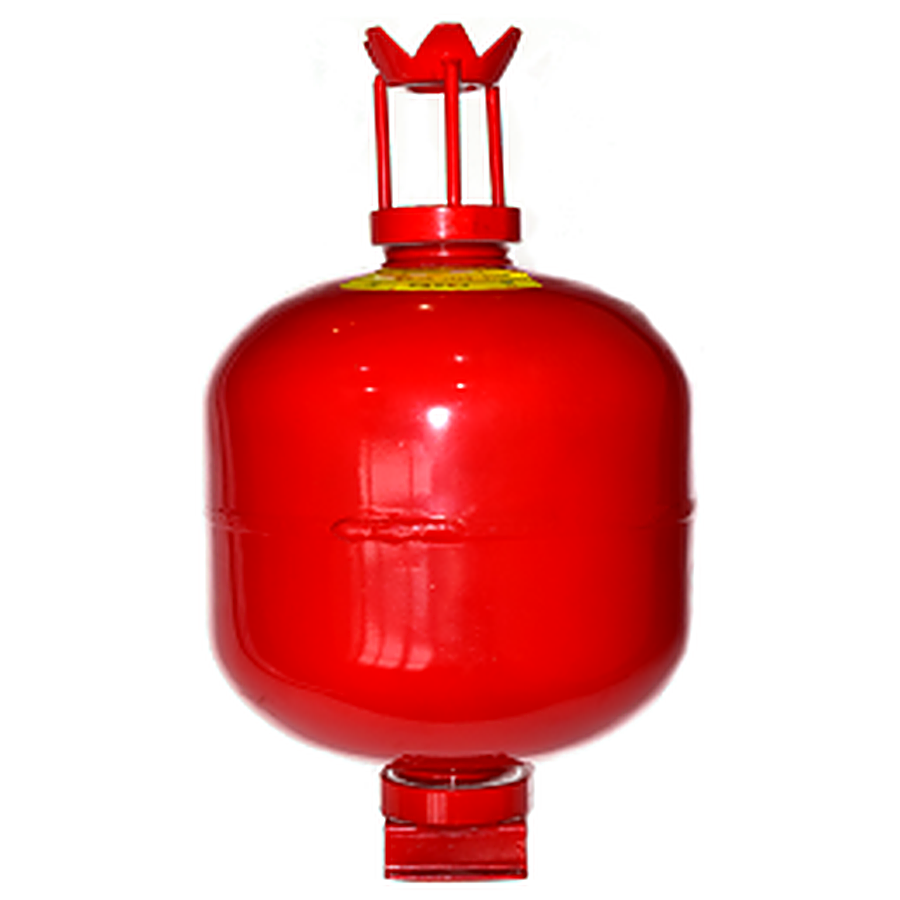
The powder sits in the container at atmospheric pressure — no nitrogen precharge, no gauge to watch.
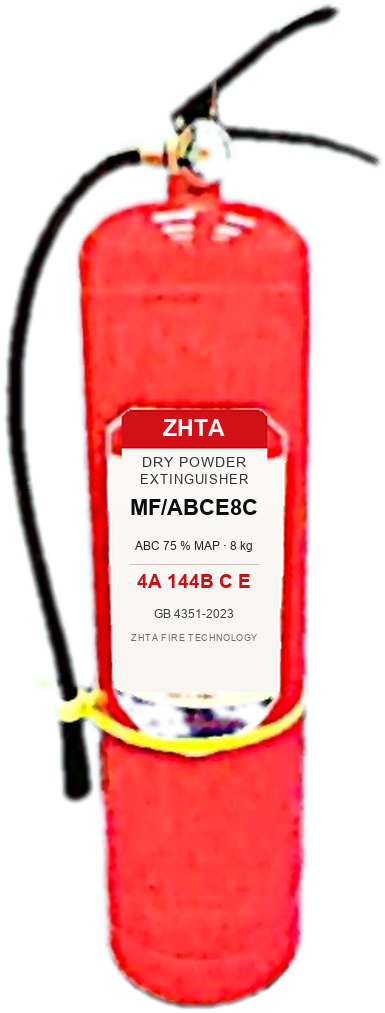
Stored-pressure ABC extinguisher in seven sizes: 1, 2, 3, 4, 5 and 8 kg handheld plus a 35 kg wheeled unit.
The agent is the easy half. The decision that actually changes the quote is the mounting format and what has to be built around it.
Hung above the hazard from 2 kg to 10 kg of charge. Fires automatically with no supply, no panel and no detector circuit to maintain or test annually.
Stored-pressure ABC extinguishers from 1 kg to 35 kg trolley, for the manual layer that codes usually require alongside any automatic system.
It will not destroy it, but it will cover it. ABC powder is hygroscopic and slightly corrosive once it has absorbed moisture, so electronics need cleaning after a discharge. Where the protected asset is a switchboard or a server rack, a clean agent is the better choice — dry powder is for spaces where the asset can be cleaned or where the priority is stopping the fire at all.
No. The heat cord is the detector and the release mechanism. That is the main reason these units are used in nacelles, tunnels and remote cabinets, where a detection circuit would need maintenance visits of its own.
Class A solids, Class B flammable liquids, Class C gases and Class E energised electrical equipment. It is not a substitute for a wet chemical agent on cooking oil — that is a different agent and a different unit.
The container and the mounting are inspected annually and the heat cord is checked for mechanical damage; the unit itself has no electrical components to fail. Replacement cycles depend on the environment — a nacelle with vibration and temperature cycling is not the same duty as a clean indoor store room.
Send the room volume, the hazard and the standard you are designing to — NFPA, EN or GB — and the reply comes back with a sized system, a drawing set and a price, not a catalogue link.

Open WeChat, tap + and pick Scan — the code opens a chat with our export desk. Not on WeChat? Message us on WhatsApp instead.
On a phone you cannot scan your own screen — long-press the code above, save it to your album, then open WeChat → + → Scan → Album.